The Archaeology of Reading

  • What is the Archaeology of Reading?
  • Who are the Archaeologists?
  • Partner Institutions
  • Contact
  • The Books and Their Readers
  • Bookwheel Blog
  • How to use AOR
  • Downloads
  • AOR Data

Go To AOR Viewer

Category Archives: Case Studies

Case Studies

On Readers and Repetition

Posted on: September 1, 2015 Chris Geekie Leave a comment

The complexity and density of the marginalia found throughout the Domenichi/Guicciardini volume makes it difficult to describe—let alone categorize—Harvey’s peculiar manner of annotation. As I mentioned in an earlier post, he doesn’t seem particularly interested in responding to the printed text. Originally, I referred to Harvey’s practice in this instance as that of writing a “manual,” ideally for the training of a gentleman of the court. I still feel that this is the case; that is, I feel that Harvey intended for his annotations to be not only read but also used by his reader as an aid to becoming a more virtuous person.

One indication that the text is intended to be used can be found in the frequent repetition of names, book titles, and concepts in the form of digestible phrases, almost always in Latin. Harvey himself explains the pragmatic scope of this repetition in one of the few marginal notes that contains some degree of reflection on the activity of annotating.
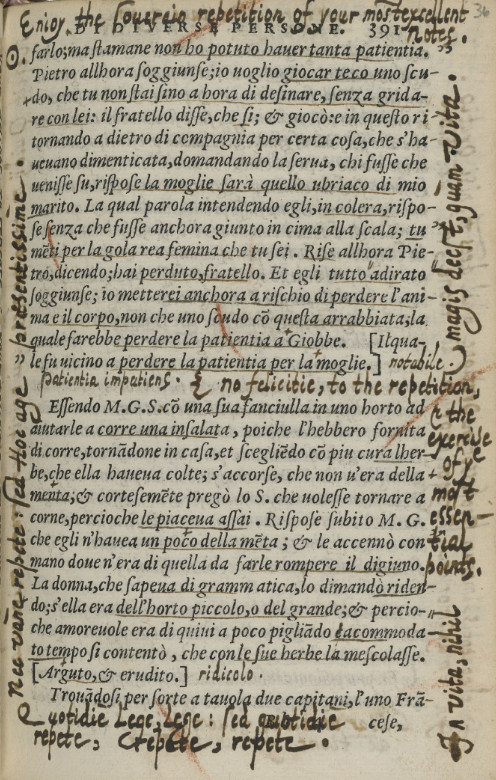
Full Page

This entire page contains marginalia calling on the reader in English to embrace repetition. Immediately in the top margin we find:

Repetition
“Enjoy the soverain repetition of your most excellent Notes.”

Farther down the page in the middle of the text, Harvey reminds his reader that happiness is not necessarily the goal of such activity. Instead, repetition is an essential form of exercise.
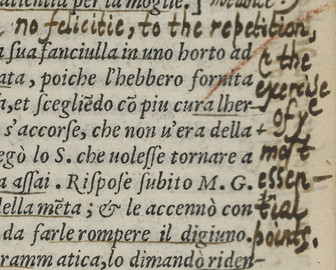
No felicitie
“No felicitie, to the repetition, & the exercise of the most essential points.”

Exercise, practice, habit, self-improvement—these are crucial elements in Harvey’s manual, and the words themselves return frequently. And in case the reader hasn’t yet learned this message by heart, the remaining Latin phrases on this page offer further exhortations. In the bottom margin, we find:
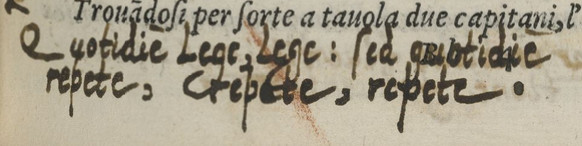
Quotidie lege, lege
“Read, read daily. But also repeat, repeat, repeat daily.”

The usage of the imperative mood offers further evidence of the practical nature of these marginalia. Here and elsewhere, the verbs cease to describe the world and begin to tell the reader what to do. Indeed, in the left margin of this same page, Harvey orders his reader to engage actively with the text:

Nec vane
“Do not repeat in vain, but Do This most attentively.”

Repetition in itself is not necessarily a useful activity; for it to be most effective, one must be “present”—that is, reading and repeating with with one’s full attention. This note also includes a phrase that will appear occasionally throughout the volume: Hoc age (Do this).


Hoc fac et vives
“Do This, and you will live. Do This, and you will excel.”


Comede Solem
“Devour the Sun and do This.”

Unlike in other instances of the word “hoc,” here Harvey capitalizes the letter h, lending a more abstract sense to the meaning of “this.” Rather than directing his reader towards a specific act, Harvey seeks a specific behavior and attitude: Do This—not in vain, but with as much presence as possible; Do This—and live well; Do This—and devour the sun.

As a result of this insistence on reading, rereading, and contemplating marginalia as a means to practical ends, Harvey seems to have produced a sui generis form of writing. For lack of a better word, I have been calling it a manual, but the descriptive power of this label will always be partial. Much work still remains to be done on the form of the notes as a whole, which also involves making sense of the time periods in which certain marginalia were written. I mentioned in my last post that we can approximate dates ranging from 1580 to 1608. In fact, Harvey seems to have spent so much time on this project that he even had to remind himself to stop “scribbling” and simply enjoy the work that he had already produced.
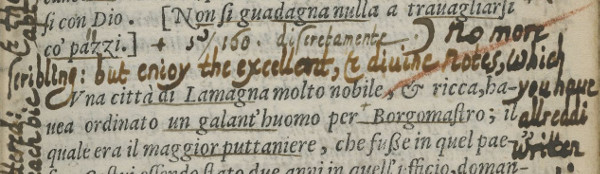
scribling
“No more scribling: but enjoy the excellent, & divine Notes, which you have allreddi written.”

About Chris Geekie

Case Studies

‘Pro se quisque’

Posted on: August 28, 2015 Jaap Geraerts Leave a comment

Transcribing all of Harvey’s annotations is not always an easy—let alone enjoyable—task, mainly because of his obsession for detail, as a result of which some transcriptions seem to be never-ending—or at least it surely feels like that. However, precisely because of this level of detail, when transcribing one sometimes encounters particular annotations that are likely to be overlooked when studying Harvey’s annotations, especially because we, almost reflexively, tend to direct our gaze to the marginal notes, which are seen as (and often prove to be) the richest and juiciest source of information.

One of these particular annotations that attracted my attention are the words “pro se quisque,” which Harvey underlined in his copy of Livy’s history of Rome. I was intrigued by this, not so much because of the meaning of the words (“everyone for himself”), but because of the fact that Harvey underlined it with dots instead of a more or less straight line. This prompted me to add another variable to the method attribute of the underline tag, further expanding the search options.

Livy, Ab urbe condita, [sig. A1r]

When continuing my transcription of Livy’s history of Rome, I was surprised to see that underscored the words “pro se quisque” more often; we have just finished transcribing Livy’s history in its entirety (!!), and it turns out that he underlined this phrase twenty-five times. Most often he would just underline these three words (fifteen times), whereas ten times he underscored them as part of a slightly larger set of words. Underscoring these words by using dots, which initially attracted my attention, proved to be quite uncommon (only five times), as he normally preferred to use lines.

Livy, Ab urbe condita, 454.

Interestingly, the words “pro se quisque” are not just underlined in the printed text, but also appear in five marginal notes. In the first of these notes, Harvey wrote: “Everyone [strove] for himself, with no king at this time. The people favoured their power, the Senate its authority. The basis was of the people. Yet Romulus was the master and the common people were the slaves, just like here” (p. 9).

The lack of strong leadership, and its negative repercussions for the Roman state, are echoed in other marginal notes as well: “For a nation that was the richest, most active as well as the shrewdest in the world it was not difficult to command kings and dominate the world. How many kings there are in one popularist city? Each one [strives] for himself.” Elsewhere he wrote: “The Roman offices served the use of the republic, not the grandeur of individual persons. Every one for himself, and those who cannot be Scipios abroad, want to be Petiliuses at home. And they have the nerve to taunt those by quibbling who they do not dare to rival by deserving well” (p. 689); and “A skillful move in a difficult situation. Everyone [strives] for himself, [see] above, below. Shyness in holding power and dealing with matters is for a boy, not a man” (p. 76).

It is also interesting that the underscoring of the words “pro se quisque” and the marginal notes that contain this phrase never coincide (i.e., appear on the same page): it was a running theme, a topic in which Harvey was interested and which he addressed throughout the book—sometimes in the form of underlining, sometimes in the shape of a marginal note. It certainly was always on his mind, for after “having thoroughly read the above two books . . . I have come to understand in the end, that it was pivotal to distinguish most clearly the curiae, assemblies, laws, magistrates, customs, even the rewards and punishments according to the type of Republic, and its form, each individually, and that all should be fitted in entirely, in the most suitable way.”

Harvey concluded that this had not always been the case throughout Roman history, “so that they [the Romans] were more prudent for themselves than for the Republic. For look wherever you wish in Roman history: everyone [strives] more for himself [my italics], than for the Republic; the devotion to the household is greater, than that to the fatherland; there are more rich and respected housekeepers than fair and wise politicians” (p. 63).

Livy, Ab urbe condita, 63.

The lengthy note continues on the next page, and Harvey argued that if the Romans had tailored their laws and political offices more closely to the nature of the Republic, this would have contributed to the well-being and stability of the state. This certainly was an important insight, and as the marginal note continued, Harvey wrote: “And for this consideration Philip Sidney, the prominent courtier, thanked me generously, and he openly acknowledged that he had never read anything of such importance either in historical or political works. That he had observed far and wide Romans who were too much senatorial in a popularist Republic and ones who were too much popularist in a Senatorial Republic, ones who were not royalist enough in a monarchy, citizens rather than subjects. And that he had no doubts whatsoever that if they had adapted themselves to the constitution of the State, that they would have come out as the strongest nation, the most successful and powerful people in the world. And this was our most important observation about these three books. . .” (p. 64).

Here the full meaning Harvey attributed to the phrase ‘pro se quisque’ is disclosed: it denotes not only people striving for their own interests at the expense of the larger, public good, but also people acting contrary to the constitution of the Republic, disturbing its balance and harmony and creating internal turmoil.

Here the full meaning Harvey attributed to the phrase “pro se quisque” is disclosed: it denotes not only people striving for their own interests at the expense of the larger, public good, but also people acting contrary to the constitution of the Republic, disturbing its balance and harmony and creating internal turmoil. Interestingly, in only two of the other eleven books in our corpus did Harvey either mention or underscore the words “pro se quisque.” He did this in two marginal notes, one in Domenichi’s Facetie (**2[r]) and one in Guicciardini’s Detti et fatti (p. 48). In both cases, the context in which this phrase appears is different from the context (and content) of the marginal notes in Livy’s book.

Although more research could be done—e.g., Did he underline all instances of “pro se quisque” in the printed text? What was the context in which this phrase was used in the printed text? Why did he use various forms of underlining? Are other marks used to highlight this phrase?—this example neatly shows the links between various forms of readers’ interventions, in this case underlining and marginal notes. For a transcriber, that’s probably the most valuable outcome of this small case study: it shows the benefit of having tagged all of Harvey’s interventions, which, if only for a moment, lightens the burden of what sometimes can be an arduous task.


About Jaap Geraerts

Case Studies, History of Reading

Poets, popes, and polemics; or, methods for dating marginalia

Posted on: July 15, 2015 Chris Geekie Leave a comment

One of the more fascinating aspects of working with the tangle of marginalia found in Domenichi’s Facetie, motti, et burle is the constant reminder that Harvey returned to and annotated the same book over a long period of time (1580–1608). Apart from clear visible differences in the quality of the handwriting and ink, there are other clues that help to date certain notes.

For instance, one might simply find the year written on the page, usually indicating when Harvey bought or finished the book. In the books that we are working with at the moment, several contain the date 1580:

Livy
Livy, Romanae historiae principis, decades tres […], 1555
Machiavelli
Machiavelli, The Arte of Warre [tr. Peter Whitehorn], 1573

Guicciardini
Lodovico Guicciardini, Detti et fatti piacevoli et gravi, 1571

Beyond this rather simple recording of the year, there are other methods for narrowing down the period of various marginalia. Since our job as transcribers requires tagging the names of people or books that we come across, I frequently end up digging through online catalogues trying to make sense of obscure names and book titles. As a result, I often find publication dates, which help determine a terminus post quem for particular comments.

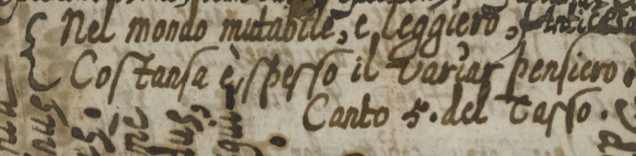
For example, on a blank page found at the end of the Domenichi text — in reality, facing the page of the Guiccardini text marked 1580 —, Harvey twice quotes the epic poem Gerusalemme Liberata by Torquato Tasso.

Tasso 1
Nel mondo mutabile, e leggiero, Costansa è spesso il variar pensiero. Canto 5. del Tasso.
Tasso 2
Eccoti, il Domator d’ogni gagliardo: come dice Tasso del bravo Rinaldo. Chi fu, ch’ardi cotanto, e tanto fece?

This poem was first published in its entirety in Italy in 1581, providing us with a rather solid chronological anchor. And given the uniformity between these notes and the surrounding annotations, it seems likely that the entire page was written by Harvey at the same time.

Using a similar approach to dating the various books referenced by Harvey, it becomes immediately clear that he returned to this same text with pen in hand much later than 1580–81. Earlier in the Domenchi, we find the following written in the head margin of a page:

Greene 1
Gascoignes Steele Glasse. Greenes Quipp for an Upstart Courtier.

And then further down:

Greene 2
The parts of the Connicatching Art. New tricks of cousenage.

Much like the vast majority of marginalia in this book, these comments have nothing to do with the printed text. Instead, both of these notes point to Robert Greene, a writer with whom Harvey quarreled in 1592 following the publication of the former’s Quip for an Upstart Courtier. That book, which contained an attack on the Harvey family, appeared in print for the first time in 1592, leading to Harvey himself publishing a response later that year, Four Letters and Certain Sonnets. The references to “Cousenage” and “Connicatching” allude to a series of pamphlets written by Greene between 1591 and 1592.

The other work mentioned, George Gascoigne’s The Steel Glas, was published in 1576 – which doesn’t really help us make sense of the chronology. But if we look at Harvey’s Four Letters, we find that Gascoigne is mentioned several times when Harvey begins belittling Greene:

“I once bemoaned the decayed and blasted estate of Master Gascoigne, who wanted not some commendable parts of conceit and endeavour, but unhappy Master Gascoigne, how lordly happy in comparison of most unhappy Master Greene?”

One wonders whether Harvey was making notes of the polemic as it was going on. Is he simply responding to contemporary events? Is he preparing remarks for his own publications? Unfortunately, any hypothesis immediately becomes much more complicated when we move across the head margin to a note on the facing page, also written with a very similar quality of ink and writing instrument.

Madd world
Its a madd world mie Masters. The title of a new booke.

This “new book” is Thomas Middleton’s play A Mad World, My Masters, first printed in 1608. Clearly these notes could not have been written earlier, but what does this date mean for the references to Greene? Or is the title of Middleton’s play an anomaly?

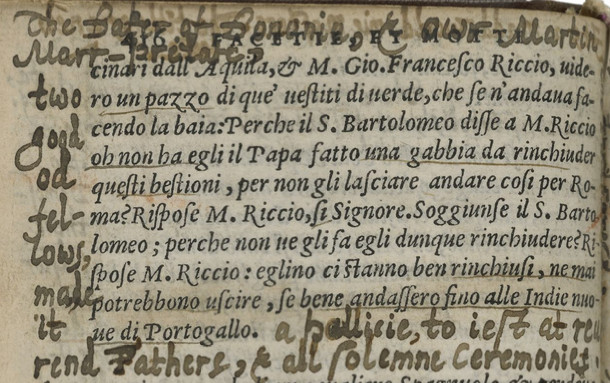
Moving forward, on the next page we find Harvey commenting about a peculiar open letter written to the pope by an anonymous Bolognese baker, and still with the same quality of handwriting and ink that appears on the previous page:

Baker of Bologna 1
The Baker of Bononie, & owr Martin Marr-Prelate, two good od fellows, made it a pollicie, to iest at reverend Fathers, & all solemne Ceremonies.

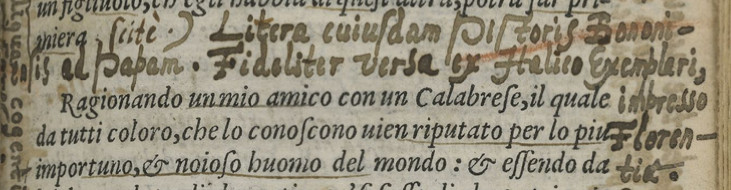
And on the facing page:

Baker of Bologna 2
Litera cuiusdam Pistoris Bononiensis ad Papam. Fideliter versa ex Italico Exemplari, impresso Florentiae.

This second marginal note is actually a verbatim transcription of the title page of a book printed only once in Latin in England in 1607, meaning that, as with the references to Tasso, we have a stable chronological anchor. Yet now, within the space of four pages, we find references to a polemic from 1592 and two books printed for the first time in 1607 and 1608.

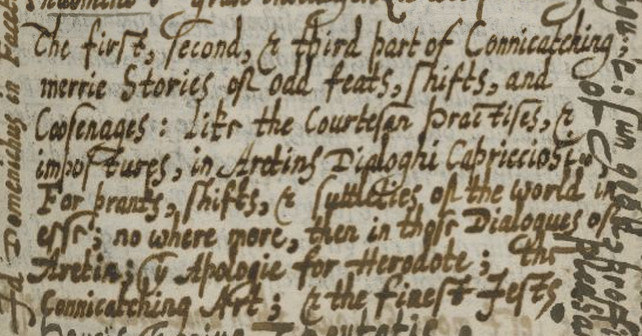
I’ll end with one more perplexing observation. Several pages after the reference to Greene’s polemical “Upstart Courtier,” Harvey again mentions his rival’s pamphlets on the art of “Conny-Catching.” Yet he seems anything but upset with his former adversary. In fact, he puts Greene on the same level as one of his other favorite writers of courtly life and merry-making, Pietro Aretino.

Greene 3
The first, second, & third part of Connicatching; merrie Stories of odd feats, shifts, and Coosenages: like the Courtesan practises, & impostures, in Aretins Dialoghi Capricciosi. For pranks, shifts, & suttleties of the world in esse; no where more, then in those Dialogues of Aretin; the Apologie for Herodote; the Connicatching Art; & the finest Jests.

It’s unclear exactly how these things all fit together, and I am happy to leave the question to much more knowledgeable and perceptive scholars.

About Chris Geekie

Case Studies, History of Reading

A look at the lightly annotated books

Posted on: May 1, 2015 Amanda Brunton Leave a comment

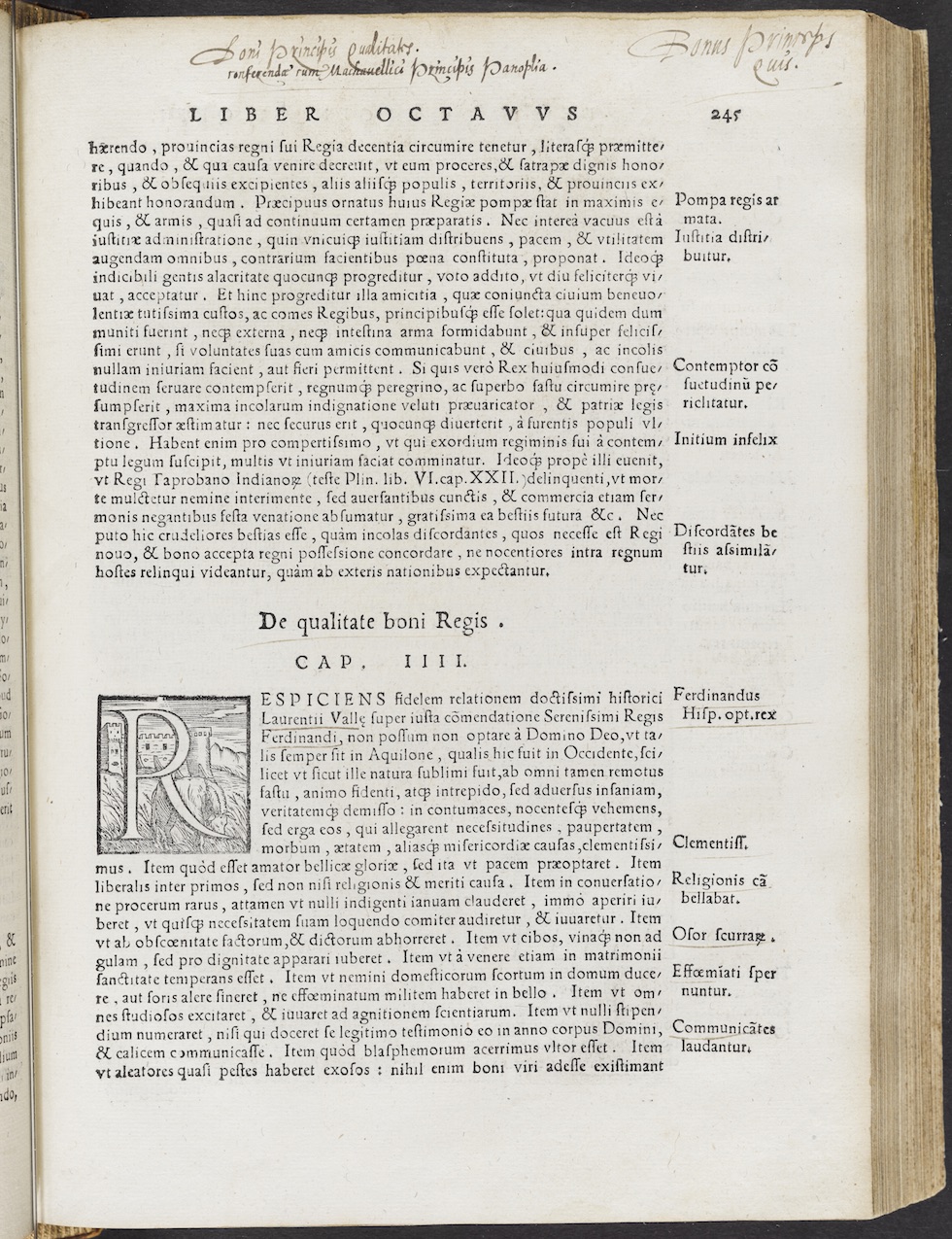
I’m Amanda Brunton, one of the research assistants working on Harvey’s marginalia as part of the Archaeology of Reading project. I joined the team at the beginning of March and will be contributing to this blog as I transcribe the marginalia. The rest of the group have been very kind in letting me get started on some of the more lightly annotated books, so while the pages that Jaap and Chris have written about below are quite densely annotated, the books that I have been working on look more like this:

Olaus Magnus, Historia de Gentibus Septentrionalibus , p. 245


Although less heavily written on, texts such as these can still provide a useful insight into the practice of annotation and the way in which Harvey used his books in conjunction with one another. I have recently finished the first draft of transcriptions of Harvey’s annotations in Historia de Gentibus Septentrionalibus, by Olaus Magnus. The Historia details the history, customs, and way of life in the Nordic countries, (complete with beautiful illustrations) and has been quite lightly annotated.


Some books seem to be lightly annotated because Harvey was primarily interested in specific sections—for example, entire chapters of his copy of Melanchthon’s Selectarum are untouched, while others contain a flurry of heavy underlining in both pen and chalk. This is not the case for the Historia, which contains small marks almost throughout—for example, underlining or little “plus signs”—yet only 33 of almost 600 pages contain written annotation.


Olaus, Historia, p.6 So many plus marks!
Olaus, Historia, p.6
So many plus marks!

This is particularly surprising because the Historia seems to have made a real impression on Harvey, informing his reading of other books in his library. For example, Harvey’s marginal notes in his copy of Machiavelli’s Art of War contains two separate references to the Historia in which Machiavelli’s strategies are compared to those described in book eight of the Historia.


Though these lightly annotated books do not contain as much discursive material as their more heavily annotated counterparts, they are still able to provide insights into the processes of reading and annotating. The Historia demonstrates that light annotation does not always indicate a lack of close reading on Harvey’s part, and that more lightly annotated books are still held in consideration when reading other books in the library. While the practice of annotation can sometimes be considered a two-way dialogue between heavily annotated texts, in this case, the Historia is a reference point in a one-way transfer of information.


This isn’t to say I’m not looking forward to transcribing some of the more challenging books, but the opportunity to work on the lightly annotated books has provided me a great insight into how these texts were read and used.

About Amanda Brunton

Case Studies

On neologisms and horses

Posted on: April 14, 2015 Chris Geekie Leave a comment

Today I’d like to share one of the many complex—and often maddening—aspects of working with Harvey’s marginalia: his neologisms.

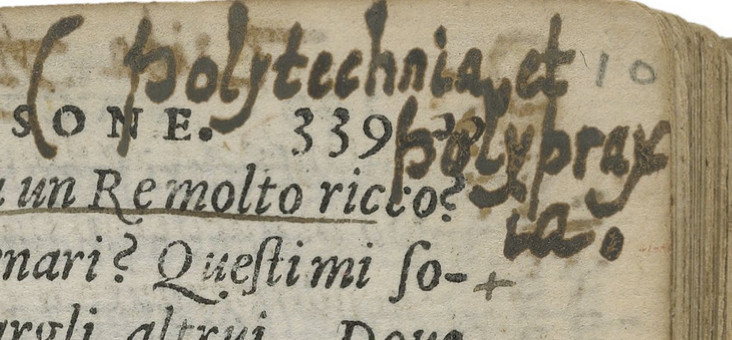
His annotations throughout the Domenichi text (which I shared in my last post) frequently contain technical words, mainly borrowed—or entirely invented retrospectively—from Greek. I say “technical” because these words seem to serve Harvey as a means of reducing a particular philosophical concept to a single term. For instance:

autotechnia

polytechnia

polytechnus

Autotechnia, Cosmopraxia, Polytechnia, Polyptaxia, Polytechnus.

Almost all of these specific examples exist in Ancient Greek literature, although they are quite rare (for example, take the entry for polytechnia in the Liddell & Scott Lexicon, which attests to only four uses in total). However, the component parts of these words are not particularly complicated, for instance: poly → ‘many’; technia → ‘skillfulness in an art.’ The problem comes from translating them into English, especially in the context of Harvey’s more compact aphorisms.

ahquando

“Ah, when Enteleches, Euschemon, Eudaemon?” One might consider translating these terms as “actual, refined, blessed.” Anyone who knows a bit of Greek will probably immediately jump to correct me, “Yes, but it could also mean . . .”

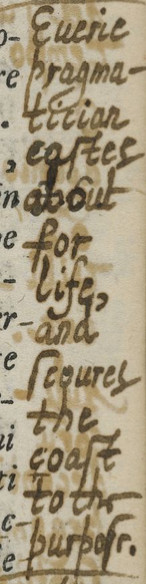
These terms are typically associated with the practical man. Indeed, immediately following this list of three characteristics Harvey writes, in English:

eueriepragmatician

“Everie pragmatician castes about for life, and scoures the coast to the purpose.” This phrase serves as a reminder that the practical person must always be on the lookout for useful things (phrases, activities, models) that contribute to one leading a fuller life. The implication seems to be that success as a pragmatician might lead to becoming Enteleches, Euschemon, and Eudaemon.

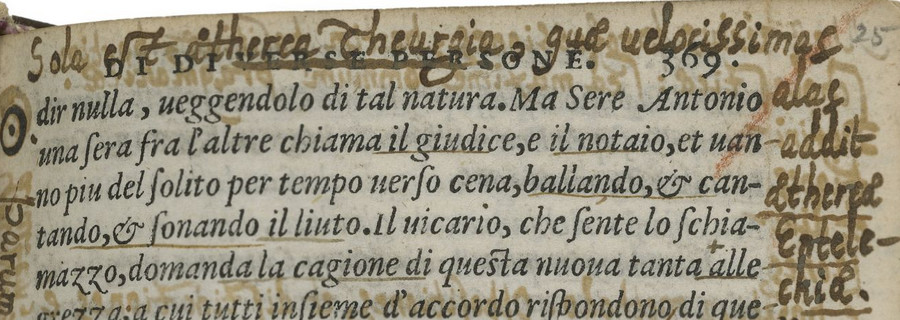
A key term that returns frequently in conjunction with practical activity is, in fact, enteleches, which also appears in the more properly philosophical form of entelechia. This word might be familiar to anyone who has studied ancient philosophy, especially Aristotle, where entelechia means something like “actualization”—as in the actualization or realization of something that exists potentially. We could translate this term as “actualization” in Harvey’s marginalia, but things become a bit trickier once we see his other, more fanciful, uses:

entelechia1

“Sola est aetherea Theurgia, quae velocissimas alas addit aethereae Entelechia.” → “Divine Theurgy alone is that which gives quickest wings to divine Entelechia.”

The meaning of this phrase is not immediately clear, which makes translating it into English rather challenging. And if Entelechia is a practical activity, what are we to make of this term Theurgia, which might be referring to magical ritual? How does “divine-working” fit with “practical actualization”?

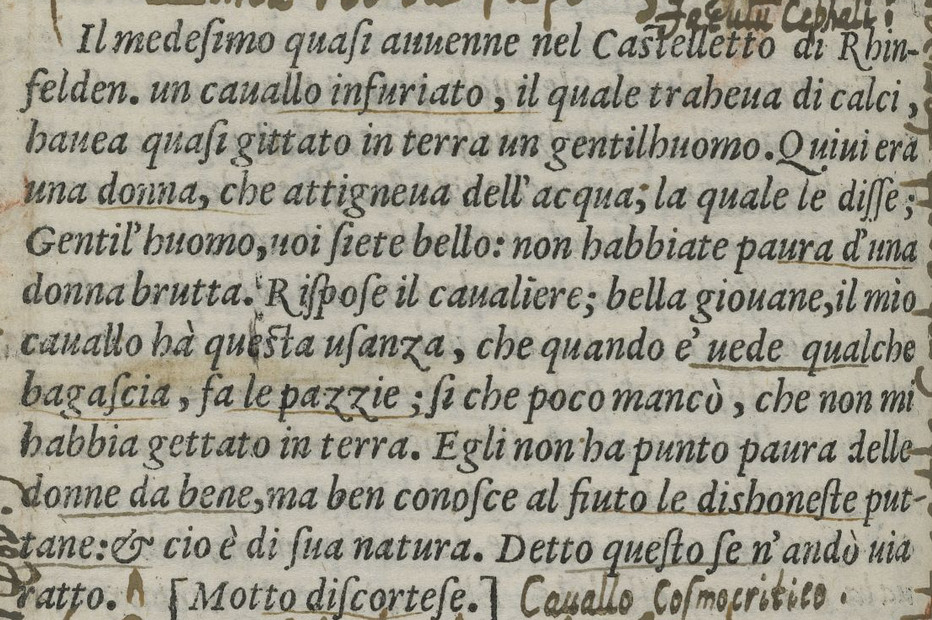
One question you might be asking yourself: Does Harvey only use these peculiar terms in Latin? In almost all cases, the answer seems to be yes. However, I have come across one peculiar instance where Harvey’s technical vocabulary makes an appearance in Italian, when he is responding to a specific joke in the book itself. As we saw in my last post, Harvey’s responses to the text are almost always brief, and not particularly interesting. Occasionally, however, something seems to strike his fancy enough to evoke a comment.

battuta

Here’s a translation and transcription of this joke, which is rather offensive:

Un cavallo infuriatio, il quale traheva di calci, havea quasi gittato in terra un gentilhuomo. Quivi era una donna, che attigneva dell’acqua, la quale le disse; Gentil’huomo, voi siete bello: non habbiate paura d’una donna brutta. Rispose il cavaliere; Bella giovane, il mio cavallo ha questa usanza, che quando e’ vede qualche bagascia, fa le pazzie, si che poco mancò, che non mi habbia gettato in terra. Egli non ha punto paura delle donne da bene, ma ben conosce al fiuto le dishoneste puttane: & ciò è di sua natura. Detto questo se n’andò via ratto.

[An enraged horse was bucking and almost threw a gentleman to the ground. Nearby was a woman drawing some water, who said, “Good sir, you’re handsome, you shouldn’t fear an ugly woman.” The knight responded, “Fair young lady, my horse has this tendency, that when he sees a tramp he loses his mind, and here he almost threw me to the ground. He’s not at all afraid of decent women, but he has an excellent nose for recognizing dishonest harlots, and that is his nature.” Having said this, he left at once.]

The editor of the book remarks that the knight’s response is a motto discortese, that is, a merely “discourteous” quip. I suppose we can’t ask too much from 16th century editors. The interesting part is Harvey’s comment.

cavallocosmocritico

“Cosmo-critical horse.”

In reality, the word cosmocriticus is an invention of Harvey’s, and it means something like “a critic of the world.” Elsewhere in the book, we find Harvey setting up this idea in opposition to another term, logocriticus.

maloesse

“I prefer to be a critic of the world than a critic of words.” Here Harvey is contrasting the man of action (i.e. the pragmatician) with the man of words. Strange that we should then find the embodiment of the critic of the world in the form of a horse.

About Chris Geekie

Case Studies, History of Reading

Harvey’s joke books

Posted on: March 18, 2015 Chris Geekie Leave a comment

Greetings, I’m one of the transcribers working on Harvey’s annotations for the Archaeology of Reading project, and I’ll also be contributing to the blog as I go along. I thought I’d start with an introduction to the text that I’m currently working on: a single volume comprising two sixteenth-century Italian joke books bound together and currently residing in the Folger Library:

Domenichi, Lodovico. Facetie, motti, et burle di diversi signori et persone private (Venice, 1571)

Guicciardini, Lodovico. Detti et fatti piacevoli et gravi (Venice, 1571)

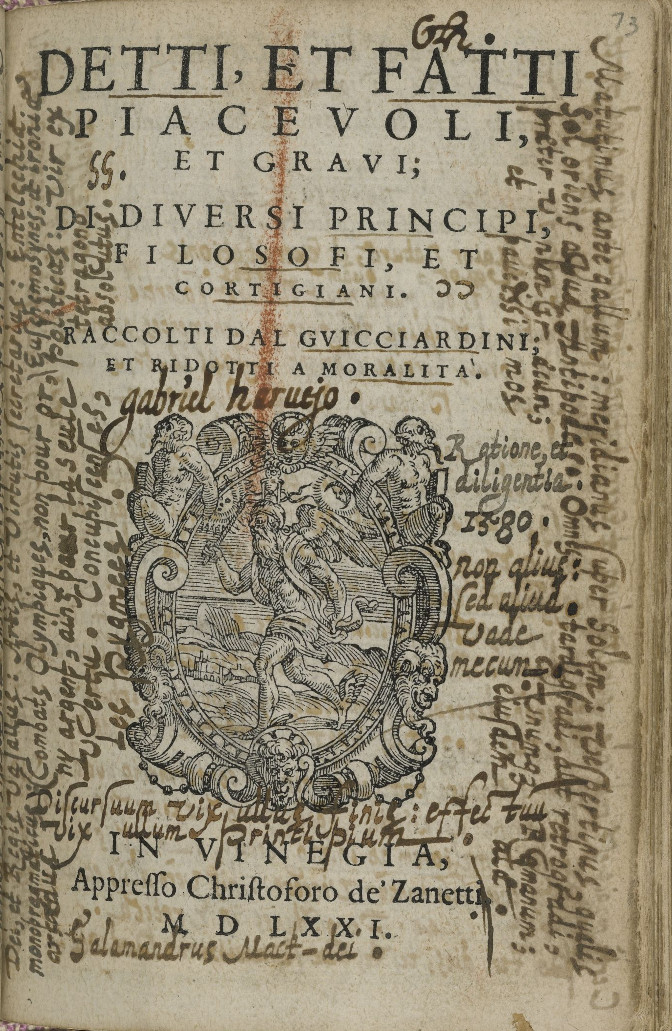
A significant chunk of the Domenichi text is missing (the first 320 pages), but here’s the title page for the Guicciardini inserted right into the middle of the volume.

small_title

You can probably see why Harvey’s use of this book is so interesting: he seems to be completely allergic to blank space.

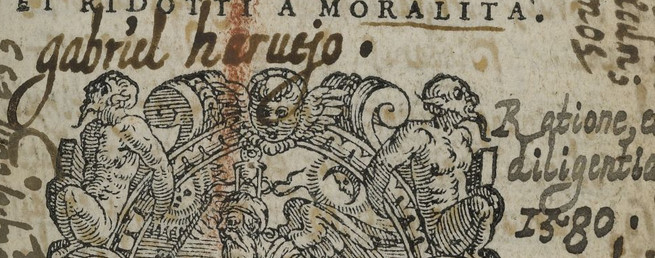
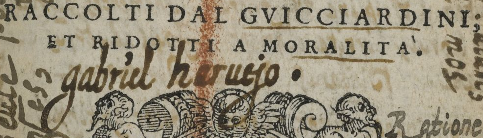
Even with just this title page, several interesting aspects of Harvey’s practice are noticeable. Differences in ink, position, and content within the annotations suggest that he came back to the book at several points and for different reasons. These layers provide some interesting clues to the way Harvey was making use of the book as an object. For instance, we see him dating and signing the page, a practice he follows in most of his other books:

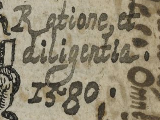
date gh

underline

He also underlines some of the text, as well as intervening to offer some orthographical corrections (note the semicolon after “Guicciardini”).

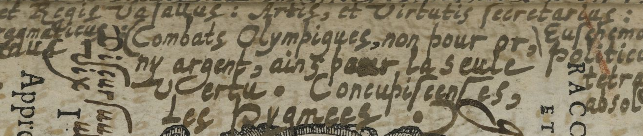
We also see Harvey’s use of different languages. Though the majority of marginalia on this page are in Latin, there is a smattering of French in the left margin:

languages

The content of this margin is also a good example of the peculiar character of Harvey’s annotations: they don’t always seem to fit together in an immediately recognizable fashion. Here we see Harvey commenting on the qualities of the professional secretary in Latin, while in French he seems to be talking about the goal of Olympic combat, which ought to be virtue and not gold or silver. An immediate connection between these two annotations might be made through the reference to Vertu/Virtutis, but it’s always difficult to make sense of Harvey’s choice of content, language, and position within the book as a whole.

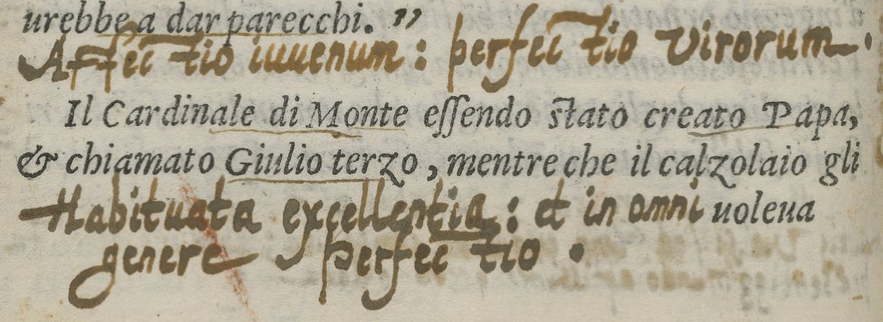
In reality, the majority of the marginalia throughout this volume rarely has to do with the printed text. Instead, Harvey seems to have used the blank space in these books to write a sort of manual or guide for the practical gentleman. “Manual” might be too strong a word, as there does not appear to be larger cohesive structure, but rather a vast sea of aphorisms, citations, and other remarks—all in various languages.

englishmarginalia

latinmarginalia

morningsun

This is not to say that there aren’t any larger conceptual patterns, and in later posts, I’ll point out some of those recurring elements.

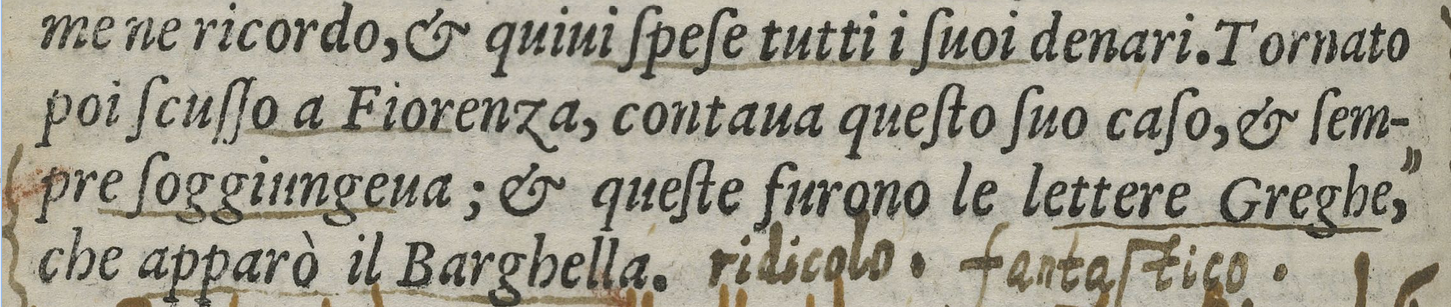
Yet, despite the overwhelming amount of material in the margins seemingly unrelated to the text, Harvey does actually respond to what he’s reading. For example, after a joke he might leave a note about his reaction.

response

The majority of these “responses” tend to follow the end of the story or joke and are typically in Italian or Latin.

dextre

savio

gelosia

In rare moments, however, Harvey seems to have been particularly fond of a joke, and his response seems a bit more personal. I’ll end with a joke that pleased Harvey so much that he wrote a comment in English.

One day, while the Archbishop of Toledo was standing at his window, he heard a peasant repeatedly beating a donkey. Moved by compassion, the archbishop began to shout from the window, “Stop, stop, or you’ll kill him, you tactless peasant!” The peasant responded, “Forgive me, m’lord, I didn’t know my donkey had relatives at court.”

[My Asse confuted.]

(It might be a bit tricky at first, but those are two s’s and an e!)

About Chris Geekie

Posts navigation

← Previous 1 2

Archives

Categories

  • Case Studies
  • History of Reading
  • Scholarly dissemination
  • Technical Development
  • Uncategorized

Recent Posts

  • Virtual Office Hours
  • School’s In Session
  • Looking Back, Looking Forward
  • The Updated AOR Viewer is Now Live
  • Down to the Detail of Dee’s Greek Marginalia
  • What is the Archaeology of Reading (AOR)?
  • Who Are the Archeologists?
  • Partner Institutions
  • Contact
  • AOR Corpus
  • Bookwheel Blog
  • Help Documents
  • Downloads
  • Dissemination
  • Go To AOR Viewer
  • The Sheridan Libraries - Johns Hopkins University
  • Centre for Editing Lives and Letters - UCL
  • Princeton University Library
  • The Andrew W. Mellon Foundation
Facebook Twitter Pinterest