The Archaeology of Reading

  • What is the Archaeology of Reading?
  • Who are the Archaeologists?
  • Partner Institutions
  • Contact
  • The Books and Their Readers
  • Bookwheel Blog
  • How to use AOR
  • Downloads
  • AOR Data

Go To AOR Viewer

Category Archives: History of Reading

History of Reading

AOR Launch in Baltimore

Posted on: January 1, 2017 Earle Havens Leave a comment

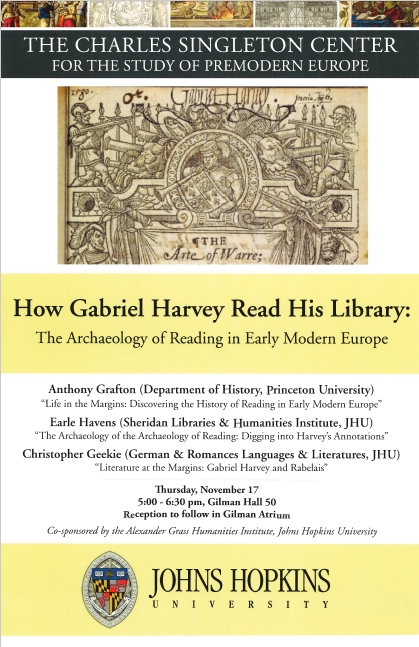
In late November 2016 the Charles Singleton Center for the Study of Premodern Europe hosted and the Alexander Grass Humanities Institute co-sponsored at Johns Hopkins University campus-wide rollout of AOR, drawing a large group of faculty, graduate students, librarians, and members of the AOR team, in particular several interesting questions from the audience on infrastructure and DH sustainability fielded by the Sheridan Libraries’ Digital Research and Curation Center staff.
JHU rollout 1

The panel started off with a wonderful retrospective from Tony Grafton on the history of obsessive-compulsive early modern readership and, more specifically, the history-behind-the-history of their often cited essay “Studied for Action: How Gabriel Harvey Read His Livy.” A large projection screen returned the gathered crowd to Princeton over 25 years ago and a wonderful, smiling photograph of Lisa Jardine accompanied by Tony’s warm recollections of their many long hours together pouring over Harvey’s notes in Livy’s history of Rome in the rare book reading room at the Firestone Library…and some particularly loud and heated debates about what Harvey was getting at, which they both enjoyed immensely. (There was no mention of librarians shushing anyone on those several occasions, but one can imagine.) Tony also recalled an essential conversation they had together with his Princeton colleague, Robert Darnton, on whether marginalia could ever really be considered a representation of the history of reading. Out of that fruitful discussion was born the organizing principle of the “bookwheel” that stands at the heart of AOR, and indeed forms the logo and the name of this blog on the AOR website. It is the idea that marginalia not only richly preserve the reading experience of a learned annotator through his immediate responses to printed texts; but, perhaps just as importantly, that they also present scholars with direct evidence of how someone like Harvey deployed the fuller resources of his personal library in the process. Harvey’s marginalia preserve, metaphorically speaking, the motions of a bookwheel filled with a multiplicity of essential books in the history of scholarship, ancient and early modern.

Harvey’s ready engagement with the contents of his uniquely formed, well-stocked library of hundreds of volumes was indeed “Studied for Action” as he “drew out all the garrisons” from his bookshelves (a phrase Harvey underlined in his copy of Machiavelli’s Arte of Warre) in order to turn his reading into tools to affect the world in his own moment: as an aspiring courtier, and as a “professional reader” advising, for example, Sir Philip Sidney on his forthcoming embassy to Prague by reading together from his annotated copy of Livy. Harvey’s compulsive, marginal cross-referencing between different books at his disposal—at times seeming to mark them simultaneously in reference to one another—has become an more frequent theme of our work since the AOR Viewer went live a few months ago, allowing us to search and track this activity systematically within individual books, and across all the books, in the AOR corpus. It will be fascinating to see the extent to which John Dee did the same in the nearly two-dozen annotated books from his library that will form the work of AOR Phase 2.

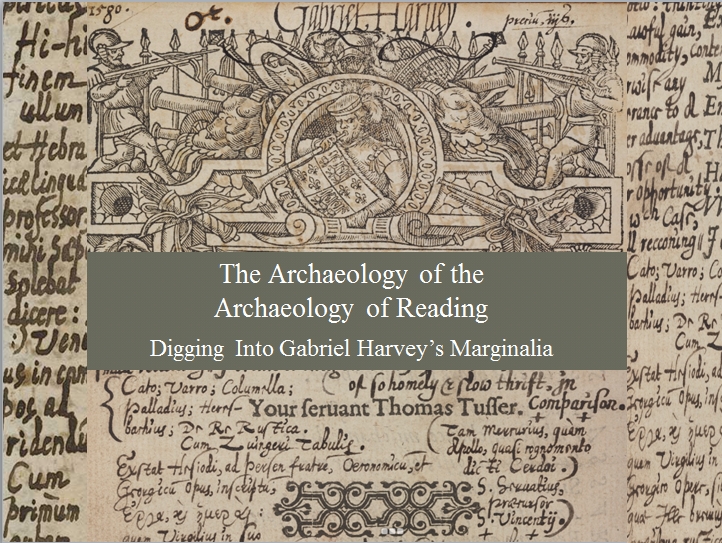
Earle Havens was up next with his own rendition of “The Archaeology of the Archaeology of Reading,” beginning with a Seneca’s old metaphorical saw about hard-reading scholars as busy bees: “We ought not only to write, nor only read…it must be gone back and forth from this to that in turns, so that whatever is collected by reading, the stylus may render in form. We should imitate the bees, as they say, which wander and pluck suitable flowers to make honey (Epistulae Morales, 84).
JHU rollout 2

There were in fact many milestones of precisely this same kind of selective wandering through books, of learned readers plucking out purple passages, and making intellectual honey: from the “polyhistors” of Greco-Roman antiquity (Stobaeus, Aulus Gellius, Solinus), and medieval encyclopedists and compilers of florilegia (Isidore of Seville, Vincent de Beauvais, Thomas of Ireland), to the essential Renaissance hunter-gatherers and organizers of loci communes (Agricola, Erasmus, Melanchthon…their pedagogical tracts prescribing organized programs of reading were printed and reprinted as De ratione studii anthologies throughout the middle decades of the 16th century). Attention then turned to the idiosyncratic process of building up a digital corpus with the full advantage of an AOR dream team comprised of Tony, Lisa, and all our colleagues at JHU, Princeton, and UCL, and to the nuts-and-bolts of pulling all that talent together to make DH honey. This is one way of thinking of the AOR Viewer: as a kind of composite tertium quid comprised of the best gathered thoughts and efforts of a diverse and committed research team.

Once the old-timers wrapped up their reflections, the panel concluded with a firework display of marginalia from JHU Research Assistant—and long-suffering transcriber of the vertiginous marginalia in Harvey’s Domenichi and Guicciardini volumes—Chris Geekie. Chris carried the show from life and archaeology in the margins to the realm of imaginative literature, taking as his case study the myriad ways in which Harvey invoked the French agent provocateur of many aspiring Renaissance wits, François Rabelais. Taking as his starting point the broad view, both modern and early modern, that Rabelais was an irreverent, potentially atheist, author, Chris asked whether that notion held up in Harvey’s repeated references to Rabelais across his marginalia, and further afield in Harvey’s printed polemics.

The AOR viewer’s search feature reveals that Harvey hardly held one stable opinion of Rabelais, and that his tone vis-à-vis Rabelais morphed according to the context of the particular texts and contexts to which he responded pen in hand. Sometimes he praised Rabelais as a supreme wit, at others he emerges as a dangerous author for readers who lack a cautious mind. Interestingly, Rabelais’s name almost always appears in the AOR marginalia in conjunction with other major contemporary authors—Pietro Aretino, Guillaume Du Bartas, and Philip Sidney—suggesting a more nuanced view of the French author than just as arch-literatus or arch-irreligious. He could also be just one star in a larger constellation of Renaissance literati whose works collectively represented to a reader like Harvey a sequence of rich literary tropes, forms, and topoi.

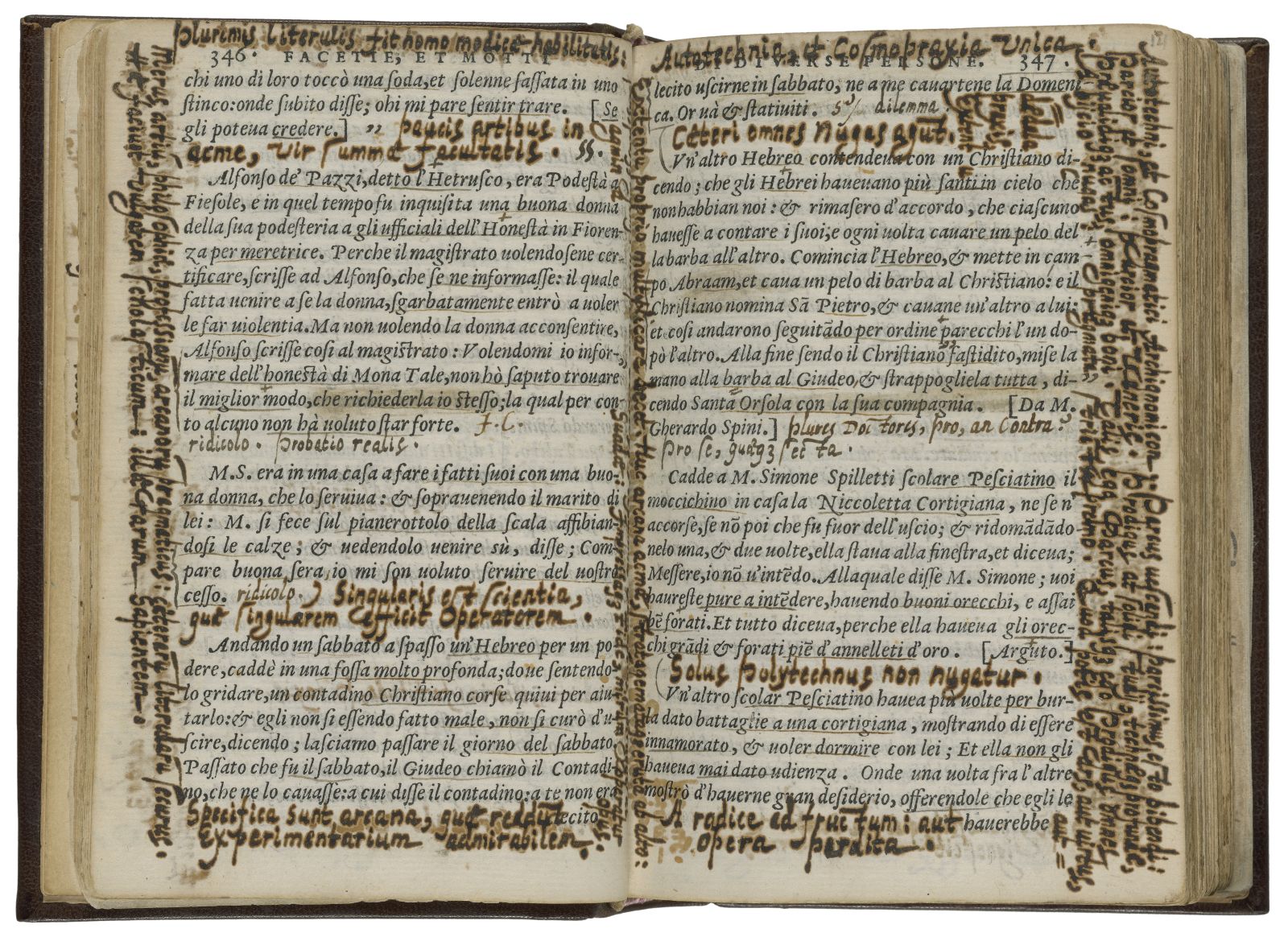
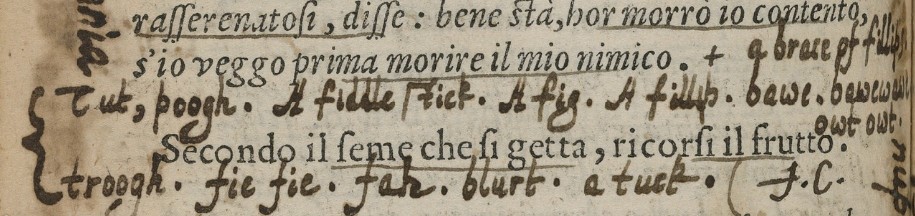
Another convention was shot through with holes by Chris’s Harvey/Rabelais investigation through the AOR viewer: the scholarly distinction often made between Harvey’s apparently distinct public opinions—which he shared with full-throated ease in his public “quarrel” in print with the University Wit Thomas Nashe—and the personal, and presumably less performative, thoughts he was supposed to relegate to the margins of the books in his private library. At key points of overlap between Harvey’s marginalia and his printed polemics, Chris found this public/private distinction also to fall apart. A passage in Harvey’s Pierces Supererogation or, A New Praise of the Olde Asse (1593) unleashed a stream of ad hominem venom on Nashe, reducing him to “the bawewawe of Schollars, the tutt of Gentlemen, the tee-heegh of Gentlewomen, the phy of Citizens, the blurt of Courtiers, the poogh of good Letters, the faph of good manners, & the whoop-hooe of good boyes in London streetes.” Distinct echoes of this bizarre, Rabelaisian wordplay appears just as loudly in the middle of one of Harvey’s highly annotated pages of Lodovico Domenchi’s Italian joke book in the AOR corpus:
JHU rollout 3.png

Clearly there is much more going on in Harvey’s two spheres of writing than has been generally realized, or realizable absent our new capacity to search thoroughly through his marginalia in a digital format. Even just a quick search for a literary persona like Rabelais in the AOR viewer, allied with additional research beyond the digital corpus, can reveal traditional public/private and print/manuscript binaries to be latter-day interpretive square pegs ill-fitted to history’s many round holes.
About Earle Havens

History of Reading, Scholarly dissemination

AOR launch in London

Posted on: October 18, 2016 Jaap Geraerts Leave a comment

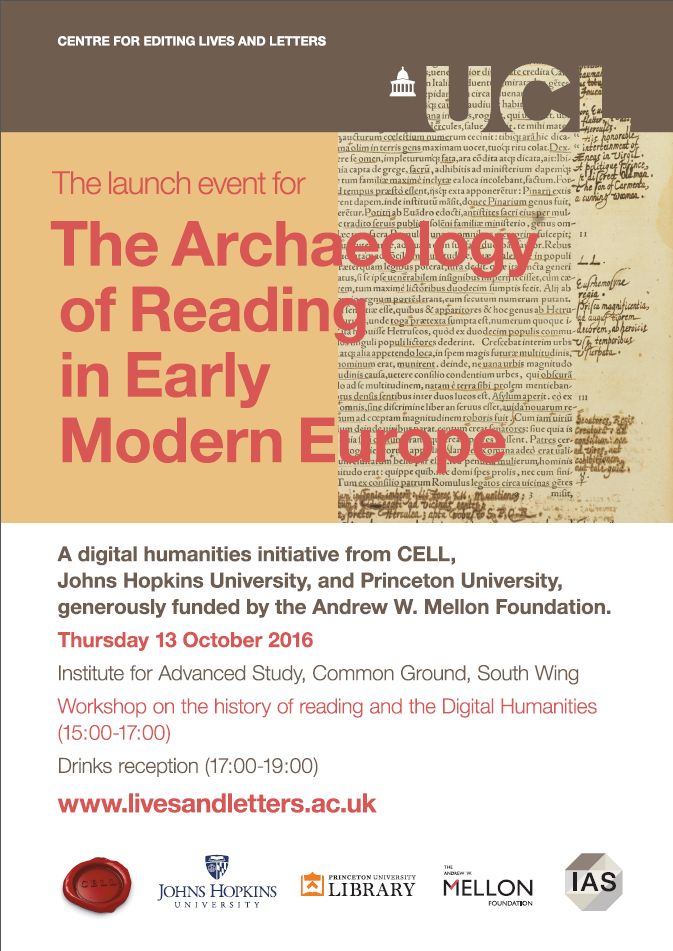
Last Thursday (13.10.2016) the UCL Common Ground provided the stage for our workshop in celebration of AOR going live earlier this autumn (see the previous blogpost). Posters and postcards had been circulating, and with clear results: the afternoon was very well attended.

UCL launch poster

A panel of AOR-anciens gave four concise, evocative presentations, intermitted with Q&A sessions.
Earle Havens started with a general introduction and spoke of the genesis of AOR, now shrouded in near-legend: the article by Lisa Jardine and Anthony Grafton, ‘Studied for Action: How Gabriel Harvey read his Livy’ (1990), and an inspired meeting between Earle and Anthony in a café in Louvain. The desire to study the history of early modern reading practices in a systematic way gave the project its spark of life.

Three themes connected the presentations: the project’s clear-cut definition of ‘big data’ as ‘too much information’ that, as Matt Symonds explained, is beyond operating with data individually. Much like for Gabriel Harvey and his contemporary readers, the conditio sine qua non for AOR has been to create a framework to deal with such an information overload – to structure the data, as Jaap Geraerts put it in his presentation on the practical aspects of constructing a XML-framework.

Second, the importance of cross-sectional collaboration. As a scholarly resource, it is vital for AOR to build that framework not as ‘words on a page’ but as a mobile, flexible creature that brings together conservational, technological, and intellectual imperatives. AOR exists by the grace of the symbiosis of its bibliographical, technological, and scholarly expertise.
And third, the way in which AOR broadens the research horizon. As became apparent during the Q&A sessions, a resource like this makes new research questions possible: to compare Harvey’s marginalia with Harvey’s own books, for example. Or, as Arnoud Visser from the University of Utrecht suggested in his presentation in which he approached AOR from the viewpoint of an end-user, to start reading between the lines of marginalia and look at what is omitted, not talked about, or implicitly alluded to. Other interesting questions arose during the Q&A, for example asking about the curatorial aspects of assembling the corpus.

When we say workshop, it was only the first leg of the afternoon. The panel discussion was followed by a reception in the Common Ground, during which both the Leffe and the inspiration flowed lavishly. If you want to (re)visit the workshop: a video will be made available in the near future.

About Jaap Geraerts

History of Reading

AOR has gone live!

Posted on: September 16, 2016 Jaap Geraerts 1 Comment

As you might have noticed, this week our site was updated to version 2 as AOR has gone live! This update does not only include some cosmetic changes to our site, such as the button which takes you straight to the AOR viewer, but also comprises several documents, such as a short biography of Harvey, bibliographical entries of each of the books available in our corpus, a piece on the history of reading, a note on the technical infrastructure of the project, and the user documentation.

In order to celebrate the launch of AOR, our senior programmer Mark Patton has gathered some fun facts about the project:

The AOR project was a lot of fun and also a lot of work. Here are a few facts concerning the work we did and the data we produced.

1) 13 books
2) 5,877 page images taking up 511 GB of storage space
3) 5 transcribers and checkers
4) 2,686 XML transcriptions making up 226,948 lines
5) 4,577 commits by transcribers to GitHub repository holding XML transcriptions
6) 940 commits by programmers to source code GitHub repository
7) 43,324 lines of Java code
8) 3,095 marginalia in L. Domenichi, Facetie (1571) & L. Guicciardini, Detti et Fatti (1571) made up of 36,332 words
9) 26,106 underlines in T. Livius, Romanae historiae principis (1555) of 84,326 words
10) 718 words written in the margins of T. Livius, Romanae historiae principis (1555) page 430v, the most densely annotated page in our corpus (in terms of word count)!
11) The most mentioned book in the marginalia is De Civitate Dei at 23 times.
12) The most mentioned location in the marginalia is Rome at 41 times.
13) The most mentioned person in the marginalia is Julius Caesar at 153 times.

About Jaap Geraerts

History of Reading

Sensation in the margins

Posted on: April 18, 2016 Kristof Smeyers 1 Comment

Here’s the first blog post of our great new research assistant, Kristof Smeyers! Since arriving at CELL, Kristof has been working on Frontinus’ Strategemes and the latest addition to the AOR corpus, Tusser’s Fiue hundred pointes of good husbandrie, which has been recently acquired by Princeton University Libraries. Steve Ferguson, one of the driving forces behind AoR, has been so kind to supply us with high-res digital images of this great book, which for several decades has been part of a private collection.

Kristof’s blog heralds a period of more regular updates on the AOR site, including more in-depth information on the bookwheel viewer we have been working on, so stay tuned!

—

Blog Kristof 1

Historians have always had a knack for comparing their work ethos with that of other disciplines. Often it would be the wider world’s forcing these comparisons on them, but just as often they themselves would reach for far-fetched metaphors to mold their scholarly selves. Especially since the second half of the nineteenth century, when history professionalized, they have compared themselves (or are compared) to a variety of personae: historians are treasure hunters, miners, detectives, judges, but also gardeners, janitors, or even taxidermists.

But an older, seemingly more natural and spontaneous comparison is the one between history and archaeology. Historians and archaeologists have always been considered scientific siblings. And it’s that family I am now part of. My name is Kristof Smeyers and I’m a cultural historian, and since March one of the archaeologists of early modern reading.

This is not the first historian’s mask I have worn. A few years ago, I was a miner in the underground tunnels of the Bodleian Library in Oxford, delving for fossilized treasure: seventeenth-century star maps, early nineteenth-century political caricatures and pamphlets, tiny anatomical sketches, and massive books of old English cartography. Deep underground, I realized for the first time that books are not just carriers of text (and context), but also objects. Books are history of course; but books shape history too, and have a history of their own.

Archaeologists work with objects. With such materiality comes a sensation. Objects can radiate, have an attraction. The books I have been working on in the AOR project so far, Gabriel Harvey’s annotated copies of Frontinus’s Strategems of warre and Thomas Tusser’s Pointes of good husbandrie, though not physically gathering dust on my desk, reveal themselves to me foremost as material (and visual) objects and intrigue me. The Dutch historian J. Huizinga coined the term “historical sensation” for exactly such an experience: a “direct” link with a past and, implicitly linked to that directness, with an authentic, unvarnished truth.

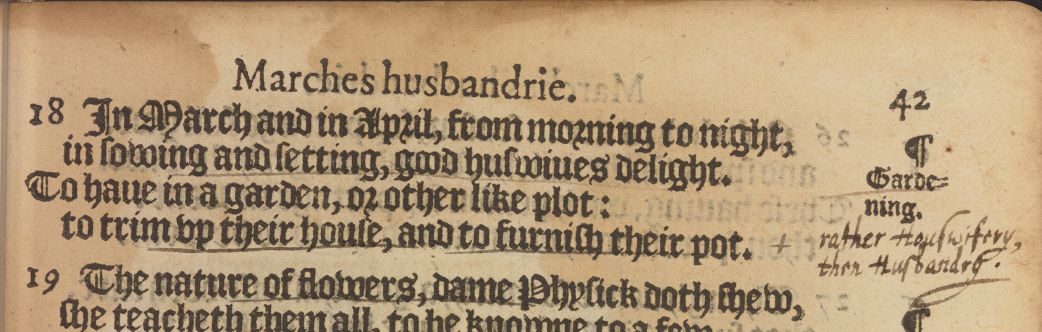
Harvey’s annotations are sensational because they not only reveal reading practices but also show a man interested in both the daily and the sublime. His light annotations in Tusser’s month-by-month manual for the ideal farmer consist mostly of surreptitious underlinings and marginalia that paraphrase such examples of farmer’s wisdom as “What a greater crime, than loss of time” or “‘Sweet April showers do bring May flowers.” Occasionally, when Tusser expands on another husbandly duty, such as tending to the herbs in the garden, Harvey underlines and objects: “rather Houswifery, then Husbandry.”

Blog Kristof 3

Ideas of manliness are more explicitly annotated throughout Frontinus, in which Harvey draws his Mars symbol for war and violence frequently. Here it’s the sublime that captures Harvey’s attention, the beauty and the brutality of war and strategy.

Blog Kristof 2

These marginalia objectify the book and open a portal to history: the handwritten references to the classics, the pedantic corrections Harvey added to the printed text (commas, hyphens, apostrophes, and missing words), the way in which he underlined with the same vigor the clubbing of cowardly soldiers (“souldiours crienge”) by Marcus Cato and the clubbing of moles in the garden—for the historian, these annotations are sensational because, for a moment, they cut through the crust of time. They can do so because of their anecdotic nature.

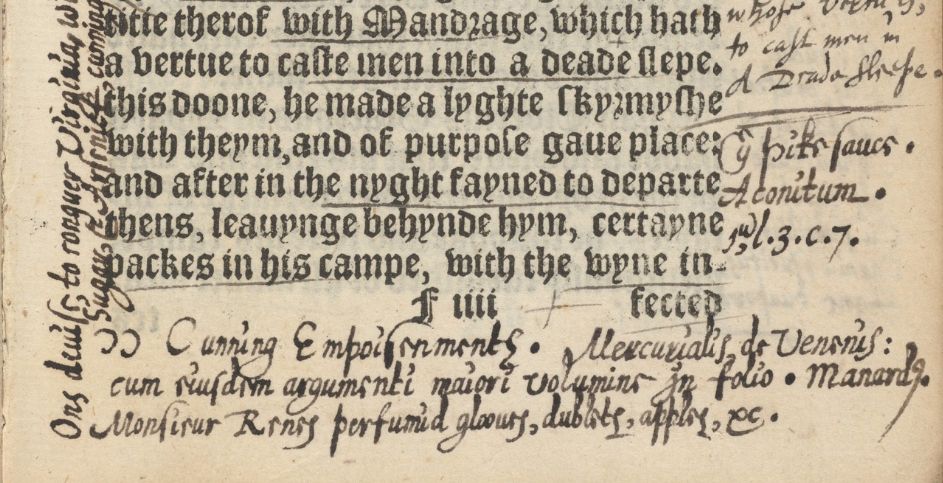
But the Archaeology of Reading project aims to systematically illustrate an early modern culture of reading. In this case the historical sensation can prove to be more of a hindrance than a stimulus. The temptation to delve into the context rather than focus on the transcription can be very persuasive. The sensations of history can tug rather hard at my sleeve. When Harvey mentions a mysterious “Monsieur René” underneath the words “caste men into a deade sleepe” and “wine infected” in the Strategems, I give in and soon find myself in the company of Renato Bianco, the perfumer of Catherine de’ Medici who set up an apothecary in the shadow of the Notre Dame. Also known as René le Florentin, “maître gantier parfumeur,” he introduced a fashion for perfumed gloves to Paris. But his successful career was haunted by rumors. Stories of secret passageways into Catherine’s bedchambers, of a shady laboratory in the back of his apothecary, even of murder, and . . . of the poisoned gloves of the Queen of Navarre.

Harvey’s marginalia are a sprawling, captivating world of references, cross-references, and associations. His library is a habitat of intellectual and material culture. One can browse through his annotations and get lost in time. But historians are not only archaeologists, they must also be curators. That’s why the corpus of the project is a choice: a selection from Harvey’s library, and soon a similar selection from the library of John Dee. Such a systematic approach is a necessity, but it is one I have to remind myself of quite regularly in order to avoid what Huizinga called “the drunkenness of the moment”—a profound intimacy between object and subject that takes you to a place where the sensation of a historical object overwhelms you.

What transcribing Harvey has made me realize, is that such a direct link with the past that allows us to touch history, in the end, doesn’t have to be physical. The AOR bookwheel shows that the marginalia have a strong material—and sensational!—value even when digitized.

It’s that tension between material and digital culture, but also between archaeological method and historical sensation, that makes transcribing Harvey’s marginalia so exciting for me.

About Kristof Smeyers

History of Reading, Technical Development

Marginalia > space

Posted on: October 16, 2015 Jaap Geraerts Leave a comment

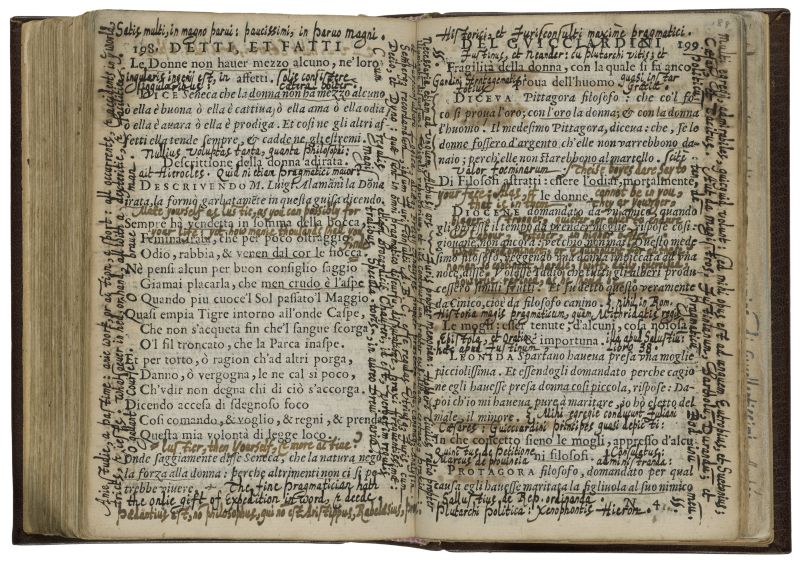
For as assiduous an annotator as Gabriel Harvey, few things would have been as annoying as running out of white space. Indeed, he often used every inch of white space available, as this image shows:

Domenichi; f. 187v - f. 188r
Domenichi; f. 187v – f. 188r

It also becomes clear that, even with sufficient space, Harvey still needed to take the layout of the printed text into account, as a result of which his marginal notes snake around and sometimes through it.

The challenges posed by the layout of the text and the size of the page made it necessary for Harvey, who could be fairly long-winded, to link parts of his extensive marginal notes to each other. Often he employed marks or symbols to establish such a link, while he also repeated the first word of the subsequent part of the marginal annotation, thereby imitating a manuscript convention that had also found its way to printed books. By including such signifiers, Harvey provided his readers with a guide as to how his marginal notes should be read.

Domenichi, f. 13v - f. 14r
Domenichi, f. 13v – f. 14r

As this image shows, Harvey enthusiastically started writing in the right margin of the page (f. 14r), but once he had written the word “aut” he found himself out of space. Therefore, he wrote an equal sign and continued the marginal note in the printed text, also starting it with an equal sign to signify the link between the two parts. Harvey still hadn’t finished though, and ran out of space again! He repeated the last word of this part of the marginal note, “Extentu,” in the left margin, where he cheerfully carried on writing. Yet the page continued to challenge him, and he found himself without space yet again. The marginal note ends with a column, a signifier that this marginal note still wasn’t finished. Harvey continued writing in the gutter of the preceding page (f. 13v), showing that he considered the whole opining, not just a side of a folio, as the page.

Now things are starting to get interesting from the point of view of our schema as well, as we’ve decided that the transcriptions capture all the reader’s interventions on a single page but we now come face-to-face with a marginal note that deftly defies the structure of our schema. This poses a challenge we need to solve, for it happens more than once. In another blog post, which is due to appear in the near future, I’ll discuss the solution we came up with.

About Jaap Geraerts

History of Reading

Pages on a screen

Posted on: August 7, 2015 Matthew Symonds Leave a comment

My name is Matt Symonds and I’m one of the researchers on the Archaeology of Reading team. I’m a historian specializing in early modern print culture and was recently interviewed by an MA student here at UCL on the topic of digitizing books. Here’s my executive summary: It’s great! It’s not so great.

When I first started graduate work, at the University of Cambridge in 2001, Early English Books Online was a thing of strange joy. Look! I can download all the books I want instead of trudging along to the UL all the way from my tiny flat on the wrong side of Fenners. I can download them VERY VERY SLOWLY. So slowly, I can go to the UL and sit in the tearoom drinking the teak-brown tea they serve there until my books appear, pop in to the Rare Books room, read my books, trudge home, and still the damn thing will be chuntering away in the background.

These days, what with roughly 10TB of storage sitting on my desk and UCL’s direct pipe straight into the heart of the Internet, I could spend all day like a latter day John Dee, downloading the perfect humanist library onto my hard drive.

And yet I don’t. I still sit in rare books rooms and archives and private collections and look and touch.

Books are far more than transmission mechanisms for Great Thoughts and Important Writing. They’re pieces of technology, a technology we’re so familiar with we’ve generally stopped thinking of it as technology. Here are some of the things we can tell about a book just by picking it up and handling it: the quality of its construction, which will tell us something about the prestige of the book, its length, where we are in the book, how much we’ve read and how far there’s left to go. And if we’re looking at specifically early modern books – well then, the binding, the paper, the stitching will tell us so much about provenance, the book’s own history.

Now, most book digitization programs are photographs of pages plugged into a web page. The greatest success of these projects has been to revolutionize many aspects of early modern research, particularly in terms of access to books. Not all scholars live near major research collections. Not all students are even allowed into major research collections. (Not all scholars or students are linked to universities able or willing to subscribe to the more commercially minded of these projects either, but that’s a topic for another day.) One of my favorite projects is the Universal Short Title Catalogue: if the book you’re looking for has been digitized, they’ll have a link as well as the usual bibliographic data. That’s just extraordinary.

But, but, but.

It’s long been a commonplace of bibliographical scholarship that each copy of a book is unique. The market knows it too. A rare books dealer recently told me that digitization has radically altered, “disrupted” even, his business. Libraries no longer have to buy just because they need a copy of a book – any copy would do – to fill a gap in their collections. So his business has changed. He now sells the unique attributes of his books, the paper, the binding, the stitching, and, yes, the marginalia.

The default digitization project remains just a picture of a page. (Sometimes with pictures of bindings too! That we should all be as good as the Folger Shakespeare Library in this regard.) Some digitizations try to offer a simulacrum of the experience of reading a book by employing a “page-turner” graphic effect. Personally I find these beyond irritating, but many don’t and feel instead that it reminds them of the materiality of the book. I’d like somehow to be more than reminded of it: I want the materiality of the book to be integral to the digitization. The frustrating thing is, I don’t know the how to that somehow—yet. But I am certain that it’s these sorts of questions that are going to drive all our digitization projects from here on in.

About Matthew Symonds

Case Studies, History of Reading

Poets, popes, and polemics; or, methods for dating marginalia

Posted on: July 15, 2015 Chris Geekie Leave a comment

One of the more fascinating aspects of working with the tangle of marginalia found in Domenichi’s Facetie, motti, et burle is the constant reminder that Harvey returned to and annotated the same book over a long period of time (1580–1608). Apart from clear visible differences in the quality of the handwriting and ink, there are other clues that help to date certain notes.

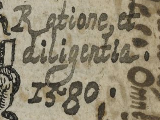
For instance, one might simply find the year written on the page, usually indicating when Harvey bought or finished the book. In the books that we are working with at the moment, several contain the date 1580:

Livy
Livy, Romanae historiae principis, decades tres […], 1555
Machiavelli
Machiavelli, The Arte of Warre [tr. Peter Whitehorn], 1573

Guicciardini
Lodovico Guicciardini, Detti et fatti piacevoli et gravi, 1571

Beyond this rather simple recording of the year, there are other methods for narrowing down the period of various marginalia. Since our job as transcribers requires tagging the names of people or books that we come across, I frequently end up digging through online catalogues trying to make sense of obscure names and book titles. As a result, I often find publication dates, which help determine a terminus post quem for particular comments.

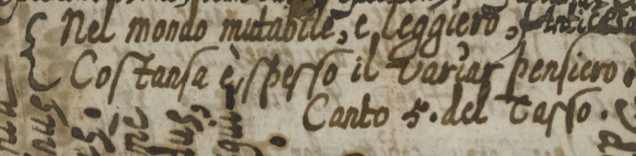
For example, on a blank page found at the end of the Domenichi text — in reality, facing the page of the Guiccardini text marked 1580 —, Harvey twice quotes the epic poem Gerusalemme Liberata by Torquato Tasso.

Tasso 1
Nel mondo mutabile, e leggiero, Costansa è spesso il variar pensiero. Canto 5. del Tasso.
Tasso 2
Eccoti, il Domator d’ogni gagliardo: come dice Tasso del bravo Rinaldo. Chi fu, ch’ardi cotanto, e tanto fece?

This poem was first published in its entirety in Italy in 1581, providing us with a rather solid chronological anchor. And given the uniformity between these notes and the surrounding annotations, it seems likely that the entire page was written by Harvey at the same time.

Using a similar approach to dating the various books referenced by Harvey, it becomes immediately clear that he returned to this same text with pen in hand much later than 1580–81. Earlier in the Domenchi, we find the following written in the head margin of a page:

Greene 1
Gascoignes Steele Glasse. Greenes Quipp for an Upstart Courtier.

And then further down:

Greene 2
The parts of the Connicatching Art. New tricks of cousenage.

Much like the vast majority of marginalia in this book, these comments have nothing to do with the printed text. Instead, both of these notes point to Robert Greene, a writer with whom Harvey quarreled in 1592 following the publication of the former’s Quip for an Upstart Courtier. That book, which contained an attack on the Harvey family, appeared in print for the first time in 1592, leading to Harvey himself publishing a response later that year, Four Letters and Certain Sonnets. The references to “Cousenage” and “Connicatching” allude to a series of pamphlets written by Greene between 1591 and 1592.

The other work mentioned, George Gascoigne’s The Steel Glas, was published in 1576 – which doesn’t really help us make sense of the chronology. But if we look at Harvey’s Four Letters, we find that Gascoigne is mentioned several times when Harvey begins belittling Greene:

“I once bemoaned the decayed and blasted estate of Master Gascoigne, who wanted not some commendable parts of conceit and endeavour, but unhappy Master Gascoigne, how lordly happy in comparison of most unhappy Master Greene?”

One wonders whether Harvey was making notes of the polemic as it was going on. Is he simply responding to contemporary events? Is he preparing remarks for his own publications? Unfortunately, any hypothesis immediately becomes much more complicated when we move across the head margin to a note on the facing page, also written with a very similar quality of ink and writing instrument.

Madd world
Its a madd world mie Masters. The title of a new booke.

This “new book” is Thomas Middleton’s play A Mad World, My Masters, first printed in 1608. Clearly these notes could not have been written earlier, but what does this date mean for the references to Greene? Or is the title of Middleton’s play an anomaly?

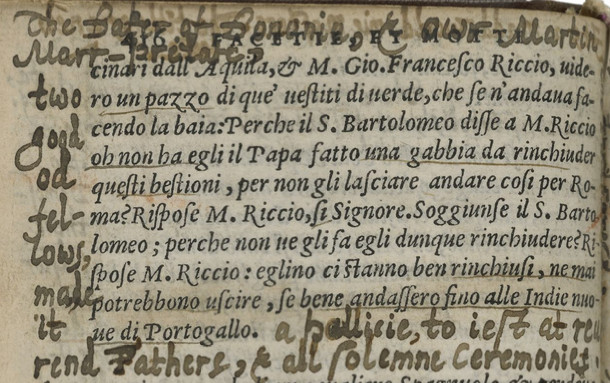
Moving forward, on the next page we find Harvey commenting about a peculiar open letter written to the pope by an anonymous Bolognese baker, and still with the same quality of handwriting and ink that appears on the previous page:

Baker of Bologna 1
The Baker of Bononie, & owr Martin Marr-Prelate, two good od fellows, made it a pollicie, to iest at reverend Fathers, & all solemne Ceremonies.

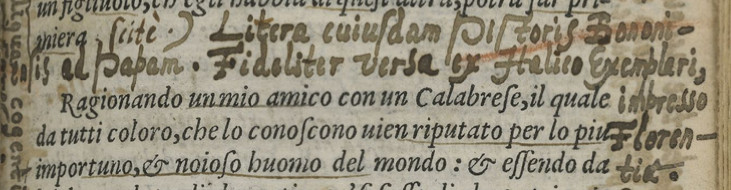
And on the facing page:

Baker of Bologna 2
Litera cuiusdam Pistoris Bononiensis ad Papam. Fideliter versa ex Italico Exemplari, impresso Florentiae.

This second marginal note is actually a verbatim transcription of the title page of a book printed only once in Latin in England in 1607, meaning that, as with the references to Tasso, we have a stable chronological anchor. Yet now, within the space of four pages, we find references to a polemic from 1592 and two books printed for the first time in 1607 and 1608.

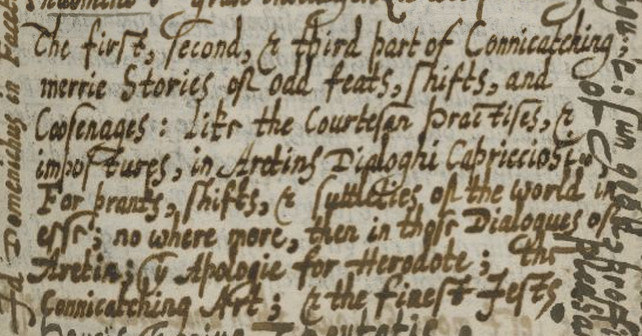
I’ll end with one more perplexing observation. Several pages after the reference to Greene’s polemical “Upstart Courtier,” Harvey again mentions his rival’s pamphlets on the art of “Conny-Catching.” Yet he seems anything but upset with his former adversary. In fact, he puts Greene on the same level as one of his other favorite writers of courtly life and merry-making, Pietro Aretino.

Greene 3
The first, second, & third part of Connicatching; merrie Stories of odd feats, shifts, and Coosenages: like the Courtesan practises, & impostures, in Aretins Dialoghi Capricciosi. For pranks, shifts, & suttleties of the world in esse; no where more, then in those Dialogues of Aretin; the Apologie for Herodote; the Connicatching Art; & the finest Jests.

It’s unclear exactly how these things all fit together, and I am happy to leave the question to much more knowledgeable and perceptive scholars.

About Chris Geekie

Case Studies, History of Reading

A look at the lightly annotated books

Posted on: May 1, 2015 Amanda Brunton Leave a comment

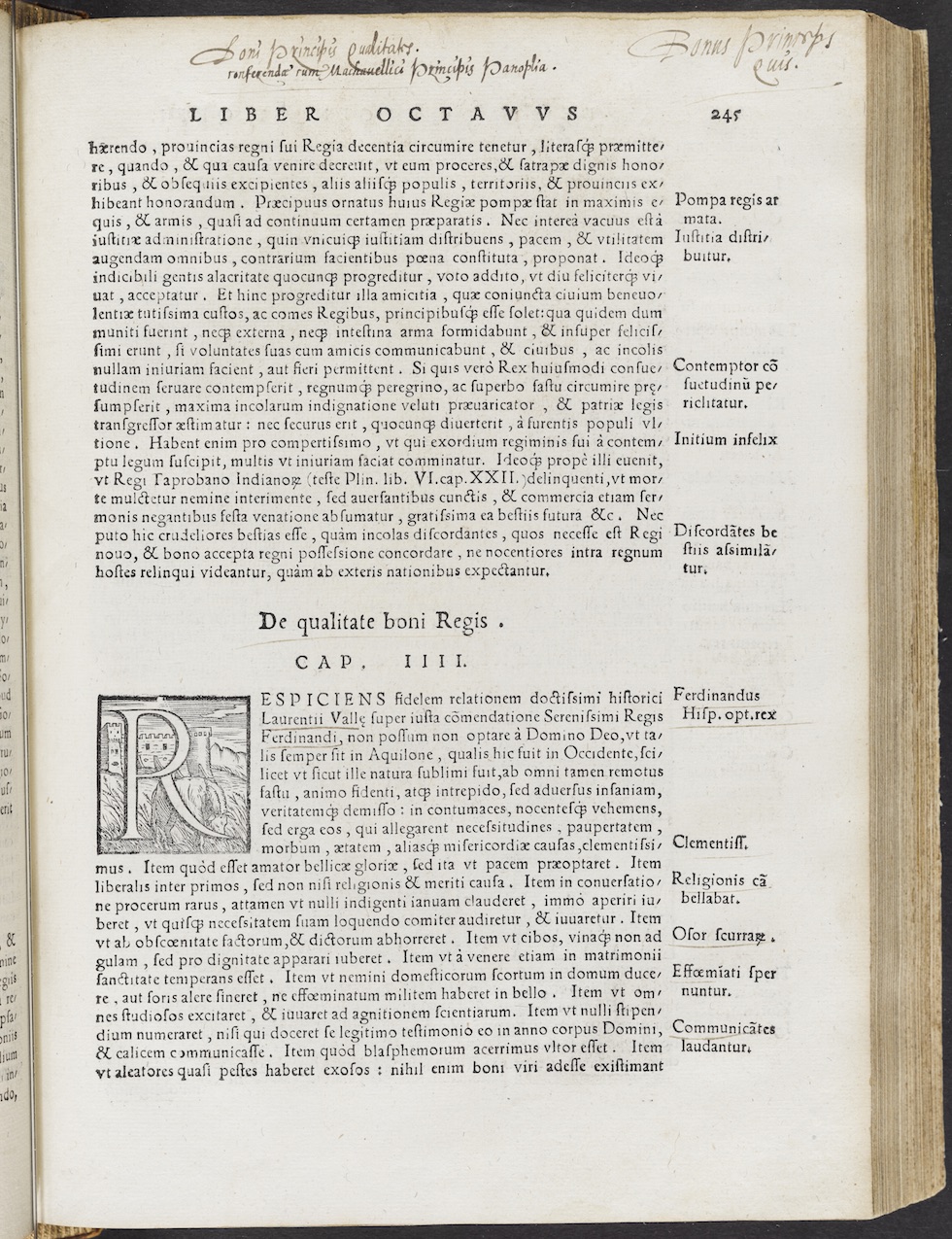
I’m Amanda Brunton, one of the research assistants working on Harvey’s marginalia as part of the Archaeology of Reading project. I joined the team at the beginning of March and will be contributing to this blog as I transcribe the marginalia. The rest of the group have been very kind in letting me get started on some of the more lightly annotated books, so while the pages that Jaap and Chris have written about below are quite densely annotated, the books that I have been working on look more like this:

Olaus Magnus, Historia de Gentibus Septentrionalibus , p. 245


Although less heavily written on, texts such as these can still provide a useful insight into the practice of annotation and the way in which Harvey used his books in conjunction with one another. I have recently finished the first draft of transcriptions of Harvey’s annotations in Historia de Gentibus Septentrionalibus, by Olaus Magnus. The Historia details the history, customs, and way of life in the Nordic countries, (complete with beautiful illustrations) and has been quite lightly annotated.


Some books seem to be lightly annotated because Harvey was primarily interested in specific sections—for example, entire chapters of his copy of Melanchthon’s Selectarum are untouched, while others contain a flurry of heavy underlining in both pen and chalk. This is not the case for the Historia, which contains small marks almost throughout—for example, underlining or little “plus signs”—yet only 33 of almost 600 pages contain written annotation.


Olaus, Historia, p.6 So many plus marks!
Olaus, Historia, p.6
So many plus marks!

This is particularly surprising because the Historia seems to have made a real impression on Harvey, informing his reading of other books in his library. For example, Harvey’s marginal notes in his copy of Machiavelli’s Art of War contains two separate references to the Historia in which Machiavelli’s strategies are compared to those described in book eight of the Historia.


Though these lightly annotated books do not contain as much discursive material as their more heavily annotated counterparts, they are still able to provide insights into the processes of reading and annotating. The Historia demonstrates that light annotation does not always indicate a lack of close reading on Harvey’s part, and that more lightly annotated books are still held in consideration when reading other books in the library. While the practice of annotation can sometimes be considered a two-way dialogue between heavily annotated texts, in this case, the Historia is a reference point in a one-way transfer of information.


This isn’t to say I’m not looking forward to transcribing some of the more challenging books, but the opportunity to work on the lightly annotated books has provided me a great insight into how these texts were read and used.

About Amanda Brunton

Case Studies, History of Reading

Harvey’s joke books

Posted on: March 18, 2015 Chris Geekie Leave a comment

Greetings, I’m one of the transcribers working on Harvey’s annotations for the Archaeology of Reading project, and I’ll also be contributing to the blog as I go along. I thought I’d start with an introduction to the text that I’m currently working on: a single volume comprising two sixteenth-century Italian joke books bound together and currently residing in the Folger Library:

Domenichi, Lodovico. Facetie, motti, et burle di diversi signori et persone private (Venice, 1571)

Guicciardini, Lodovico. Detti et fatti piacevoli et gravi (Venice, 1571)

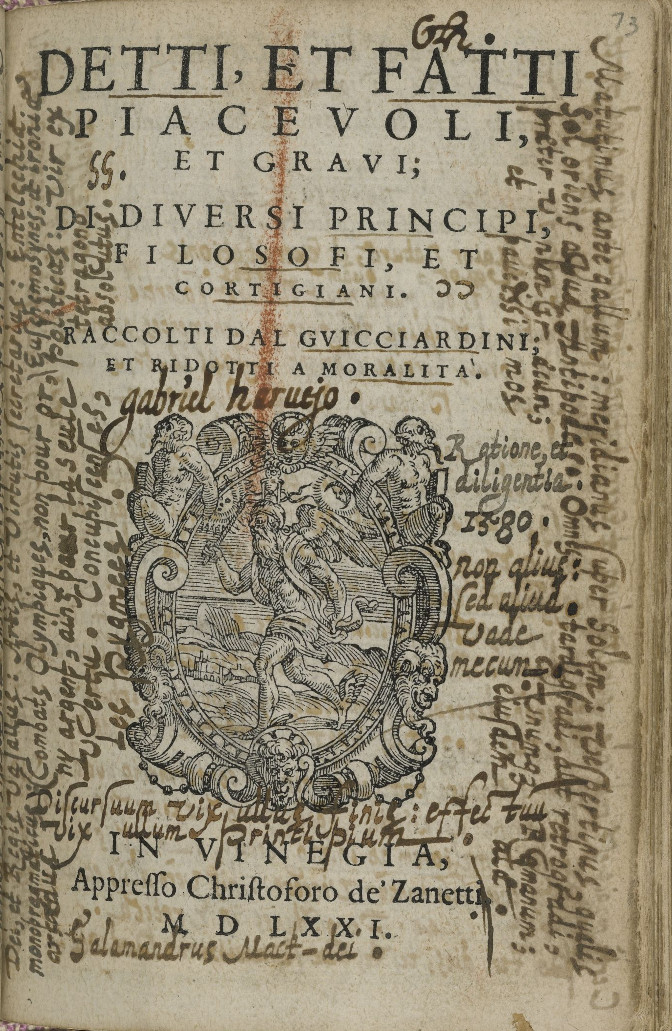
A significant chunk of the Domenichi text is missing (the first 320 pages), but here’s the title page for the Guicciardini inserted right into the middle of the volume.

small_title

You can probably see why Harvey’s use of this book is so interesting: he seems to be completely allergic to blank space.

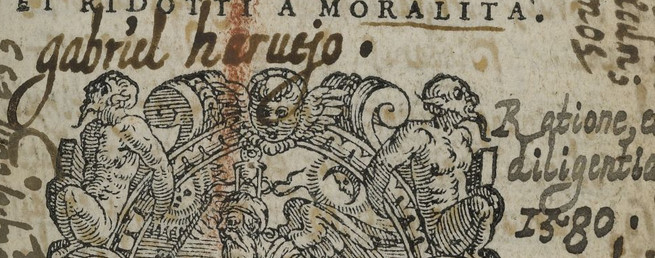
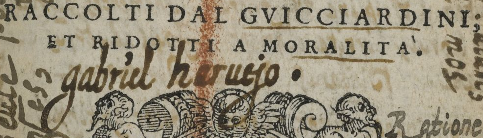
Even with just this title page, several interesting aspects of Harvey’s practice are noticeable. Differences in ink, position, and content within the annotations suggest that he came back to the book at several points and for different reasons. These layers provide some interesting clues to the way Harvey was making use of the book as an object. For instance, we see him dating and signing the page, a practice he follows in most of his other books:

date gh

underline

He also underlines some of the text, as well as intervening to offer some orthographical corrections (note the semicolon after “Guicciardini”).

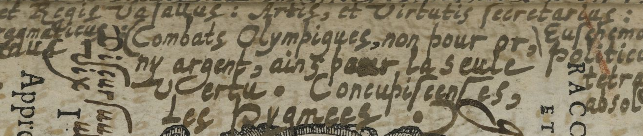
We also see Harvey’s use of different languages. Though the majority of marginalia on this page are in Latin, there is a smattering of French in the left margin:

languages

The content of this margin is also a good example of the peculiar character of Harvey’s annotations: they don’t always seem to fit together in an immediately recognizable fashion. Here we see Harvey commenting on the qualities of the professional secretary in Latin, while in French he seems to be talking about the goal of Olympic combat, which ought to be virtue and not gold or silver. An immediate connection between these two annotations might be made through the reference to Vertu/Virtutis, but it’s always difficult to make sense of Harvey’s choice of content, language, and position within the book as a whole.

In reality, the majority of the marginalia throughout this volume rarely has to do with the printed text. Instead, Harvey seems to have used the blank space in these books to write a sort of manual or guide for the practical gentleman. “Manual” might be too strong a word, as there does not appear to be larger cohesive structure, but rather a vast sea of aphorisms, citations, and other remarks—all in various languages.

englishmarginalia

latinmarginalia

morningsun

This is not to say that there aren’t any larger conceptual patterns, and in later posts, I’ll point out some of those recurring elements.

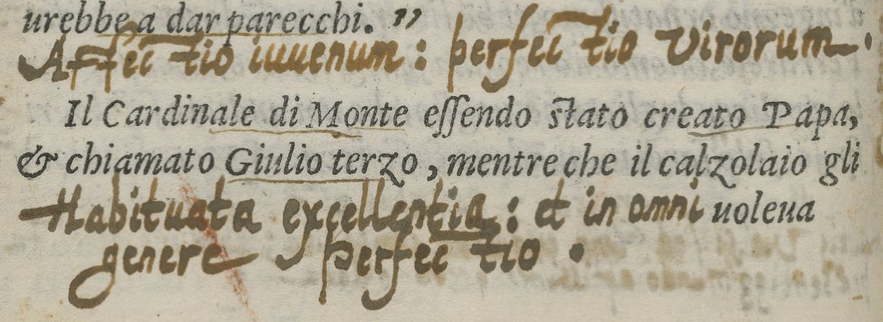
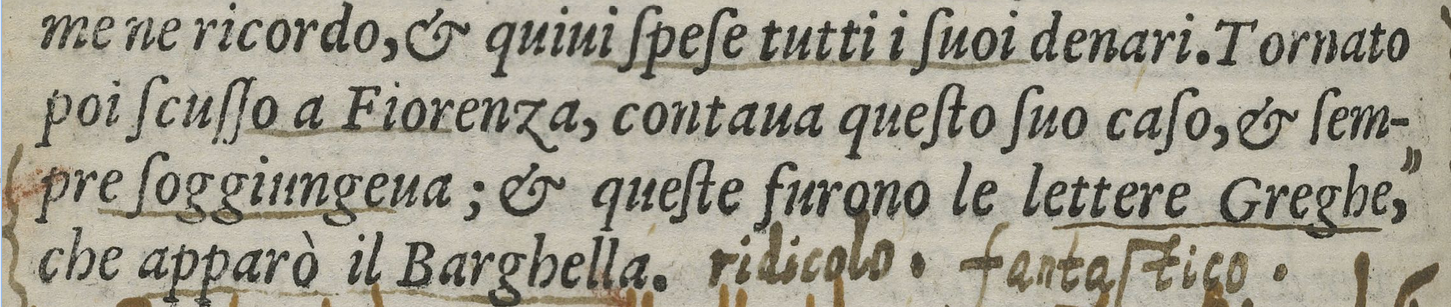
Yet, despite the overwhelming amount of material in the margins seemingly unrelated to the text, Harvey does actually respond to what he’s reading. For example, after a joke he might leave a note about his reaction.

response

The majority of these “responses” tend to follow the end of the story or joke and are typically in Italian or Latin.

dextre

savio

gelosia

In rare moments, however, Harvey seems to have been particularly fond of a joke, and his response seems a bit more personal. I’ll end with a joke that pleased Harvey so much that he wrote a comment in English.

One day, while the Archbishop of Toledo was standing at his window, he heard a peasant repeatedly beating a donkey. Moved by compassion, the archbishop began to shout from the window, “Stop, stop, or you’ll kill him, you tactless peasant!” The peasant responded, “Forgive me, m’lord, I didn’t know my donkey had relatives at court.”

[My Asse confuted.]

(It might be a bit tricky at first, but those are two s’s and an e!)

About Chris Geekie

History of Reading

Getting started!

Posted on: March 13, 2015 Jaap Geraerts Leave a comment

This is the first of many blogs to be written by members of the Archaeology of Reading (AOR) project. The blogs will deal with various aspects of the project, such as the scholarly and technical questions we face on a daily basis, and aims to offer a look behind the curtains. So stay tuned for regular updates!


One of the first questions that needed answering at the start of the project was how to capture all the annotations made by Harvey, a prolific annotator. Indeed, Harvey, can be considered some sort of a prodigy when it comes to annotating, as he not only wrote comments in the margins of the pages but also made use of an elaborate system consisting of symbols and non-verbal marks.

Blog 1 picture 1

In order to get an idea and an overview of Harvey’s “annotation system,” in February 2014 some members of the team, including Earle Havens, Matt Symonds, and Jaap Geraerts, traveled to the Princeton University Library, which owns a number of Harvey’s books that have been digitized and incorporated into this project. In snowy Princeton, where we received a warm welcome from the rare books librarian and our project collaborator, Stephen Ferguson, we spent a happy week examining Harvey annotations and inventorying the interventions he had made in the texts.


A little bit in advance of the official start of the project, we started thinking about the best way to capture Harvey’s annotations in XML, a machine-readable mark-up language that allows us to engage with the transcriptions we are making of all the annotations in each of Harvey’s books. The development of the XML schema, as it is called, was very much an incremental process and led to frantic drafting on the blackboard in the Centre for Editing Lives and Letters (CELL) office in London.

Whiteboard 2

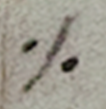
This project is a collaborative effort on the part of rare book librarians and curators, historians of early modern Europe, and IT-specialists, and after a couple of discussions with the team members from Johns Hopkins University (JHU), the schema was deemed to be ready, and we could actually start with the transcriptions! Harvey, however, continues to amaze us, and from time to time new marks are ‘discovered’, making it necessary to update the XML schema. For example, James Everest, our former research assistant at CELL, who’s now busy finishing his PhD, encountered a mark that looks like this:

Blog 1 picture 3

Our trusted Dictonario di Abbreviature Latine ed Italiane taught us that this mark means “est” or “id est,” hence it was christened “est_mark” and included in the schema. Harvey thus continues to challenge the schema, and we will keep you posted about new discoveries!


About Jaap Geraerts

Posts navigation

← Previous 1 2 3

Archives

Categories

  • Case Studies
  • History of Reading
  • Scholarly dissemination
  • Technical Development
  • Uncategorized

Recent Posts

  • Virtual Office Hours
  • School’s In Session
  • Looking Back, Looking Forward
  • The Updated AOR Viewer is Now Live
  • Down to the Detail of Dee’s Greek Marginalia
  • What is the Archaeology of Reading (AOR)?
  • Who Are the Archeologists?
  • Partner Institutions
  • Contact
  • AOR Corpus
  • Bookwheel Blog
  • Help Documents
  • Downloads
  • Dissemination
  • Go To AOR Viewer
  • The Sheridan Libraries - Johns Hopkins University
  • Centre for Editing Lives and Letters - UCL
  • Princeton University Library
  • The Andrew W. Mellon Foundation
Facebook Twitter Pinterest