The Archaeology of Reading

  • What is the Archaeology of Reading?
  • Who are the Archaeologists?
  • Partner Institutions
  • Contact
  • The Books and Their Readers
  • Bookwheel Blog
  • How to use AOR
  • Downloads
  • AOR Data

Go To AOR Viewer

Category Archives: History of Reading

History of Reading

The Archaeology of Reading Hamlet

Posted on: December 13, 2017 Chris Geekie Leave a comment

This past summer I had the opportunity to use the Archaeology of Reading to help teach a course for a group of community college students visiting Johns Hopkins. This course was part of a national, Mellon-funded initiative to bring together community colleges with research institutions such as Hopkins in order to introduce students to high level research environments in both sciences and the humanities. I was tasked with developing a syllabus that would make use of the Archaeology of Reading as a way to engage students directly in digital humanities research.

The plan was to work with the students to analyze and transcribe an annotated copy of Hamlet currently held at Hopkins:
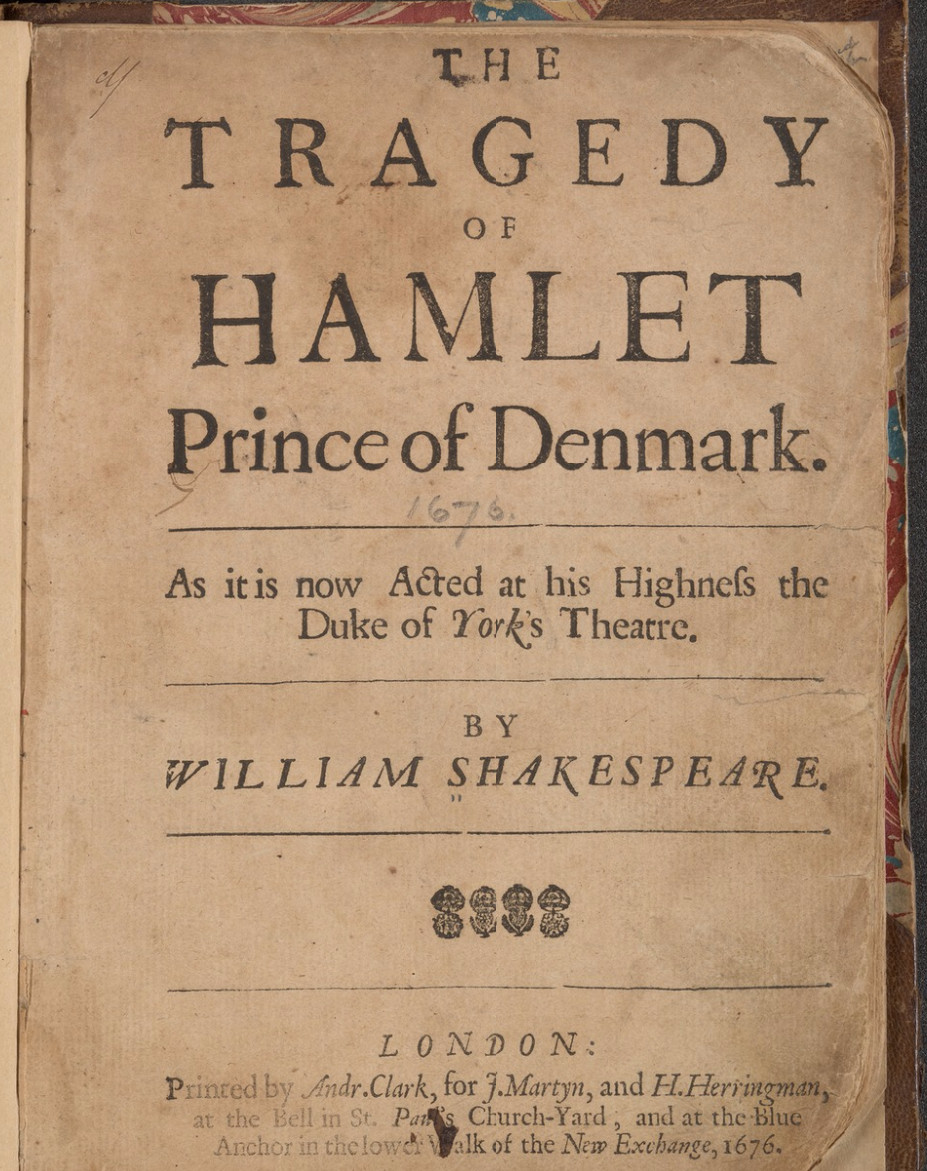
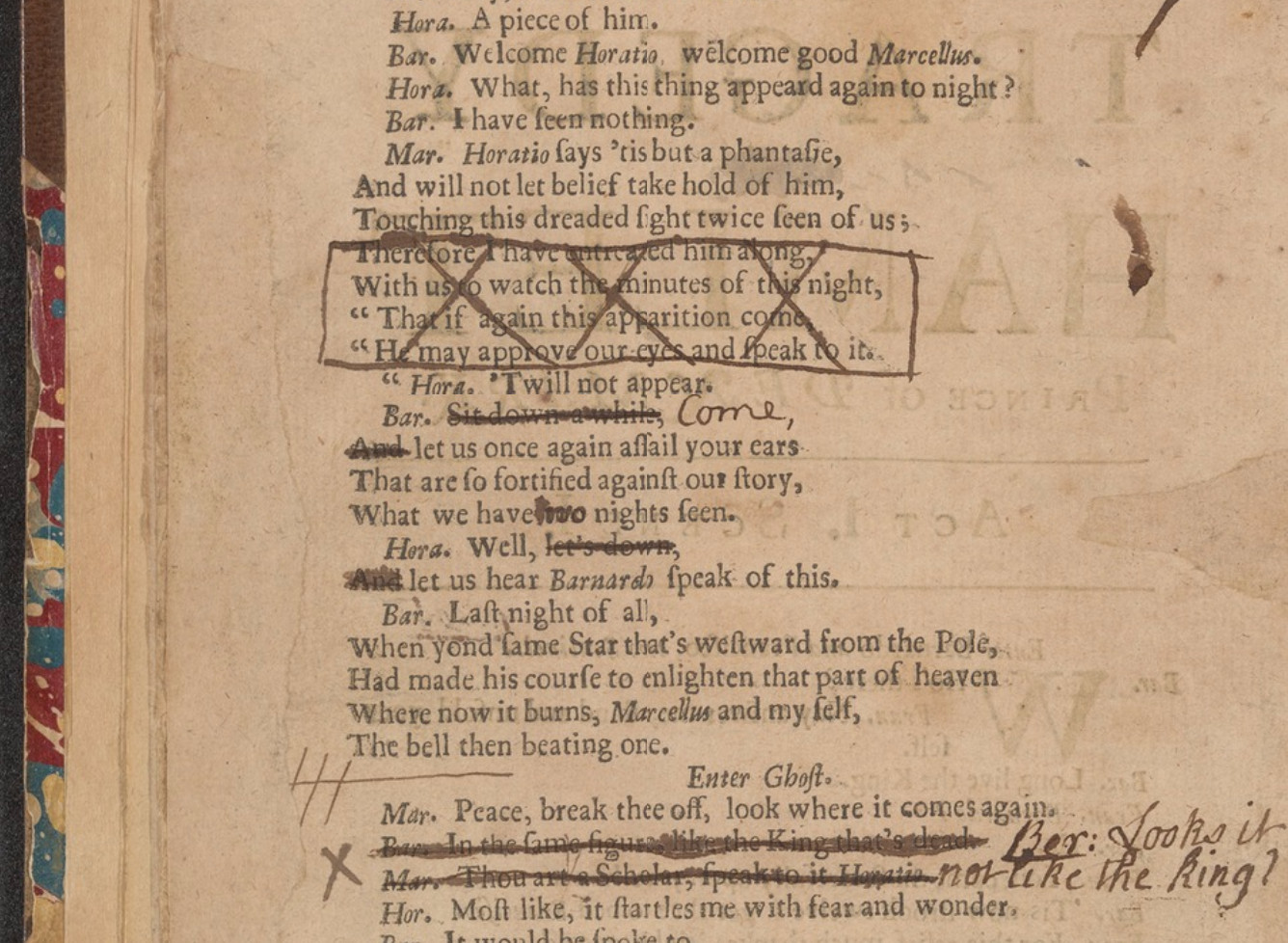
The Tragedy of Hamlet Prince of Denmark (1676)


These marginalia and textual changes are found in a copy of the 1676 edition. They were made by the 18th-century English actor and theater director, John Ward.
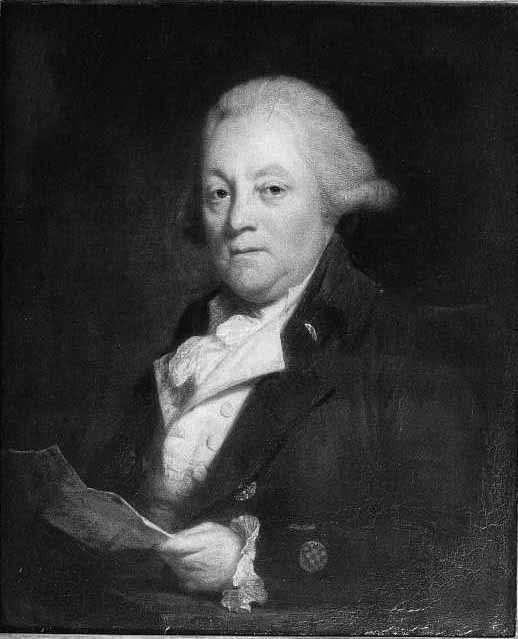
John Ward (1704-1773)

I produced a syllabus which divided the course into three sections:

1. Reading Hamlet and learning about Early Modern England

2. Learning about digital tools and environments

3. Transcribing the annotations using the workflow developed during AOR phase 1

For the first section of the course, spent a couple of weeks going through the play, talking about the plot, analyzing the characters, and discussing our interpretations. We made use of a good critical edition of the text from Oxford Classics. This edition offers useful footnotes for explicating difficult language and passages.

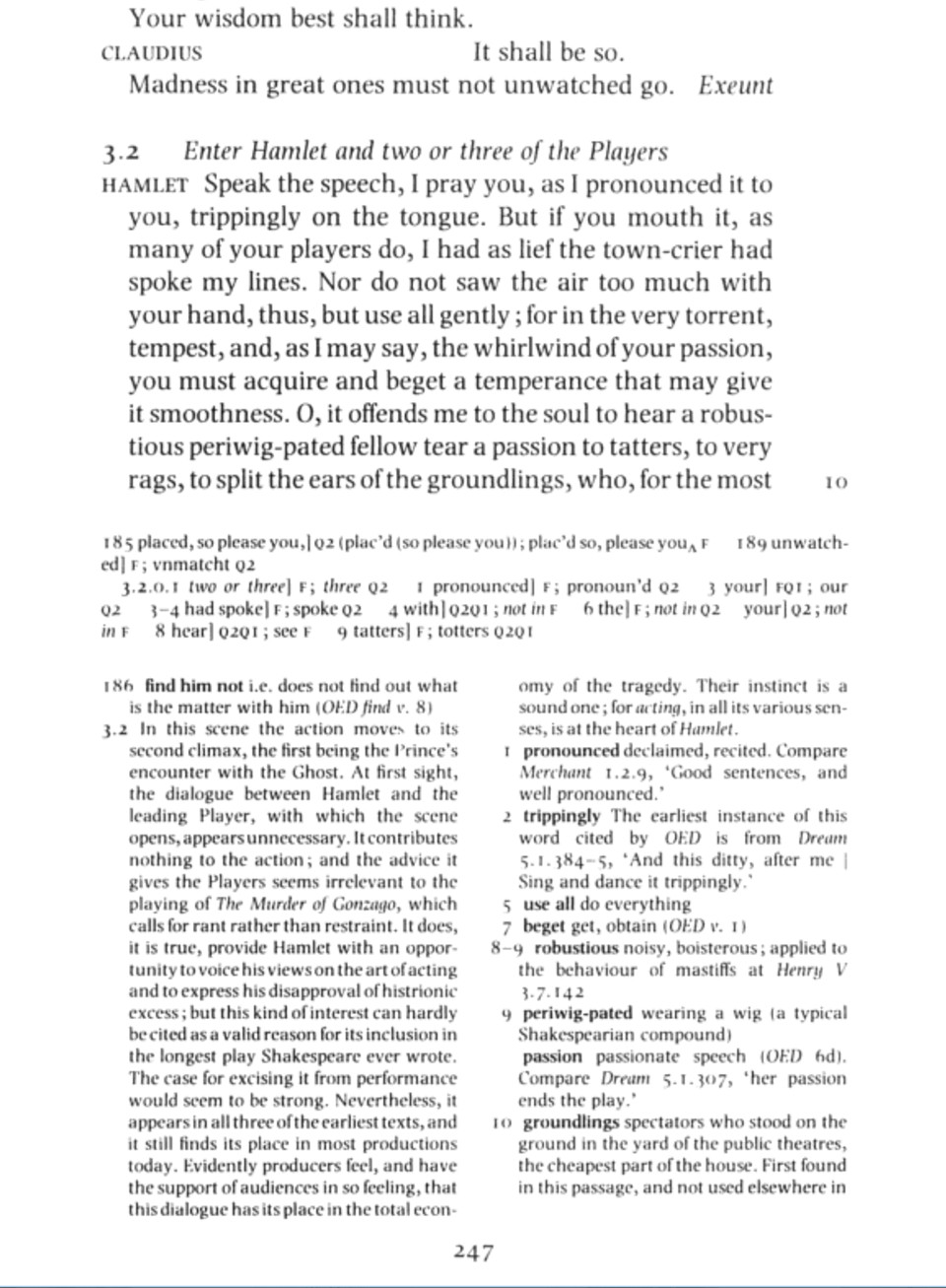
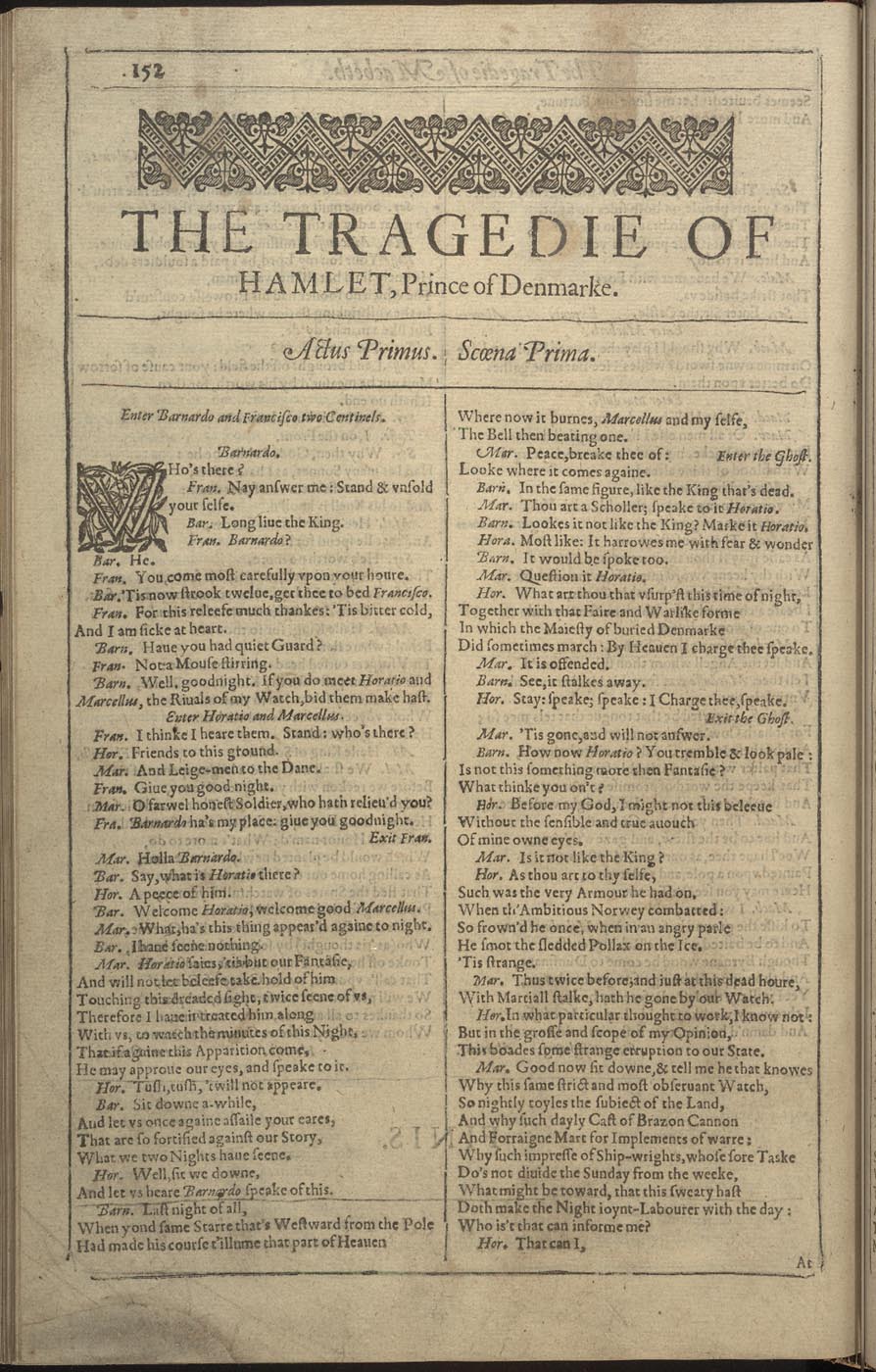
The Oxford Hamlet also provides an excellent introduction to the complex printing history of the play. In reality, there are three early printed editions of Hamlet, all of which contain substantial differences between them: the “Bad” Quarto (Q1) from 1603, the “Good” Quarto (Q2) from 1604, and the First Folio (1623).
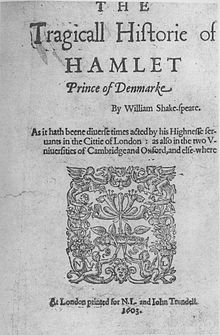
“Bad” Quarto (1603)
“Good” Quarto (originally 1604)
First Folio (1623)

The Oxford edition reproduces the text from the First Folio, while also including discussions of Q1 and providing important sections of Q2 in an appendix. As a result, not only did we discuss the play itself, but we also considered one of the central themes of scholarship dealing with marginalia, the varying interpretations and modes of reading across different periods.

From there I introduced the students to several online resources, such as Early English Books Online and the Archaeology of Reading. With EEBO, we were able to start looking at the format and layout of early editions of Shakespeare.

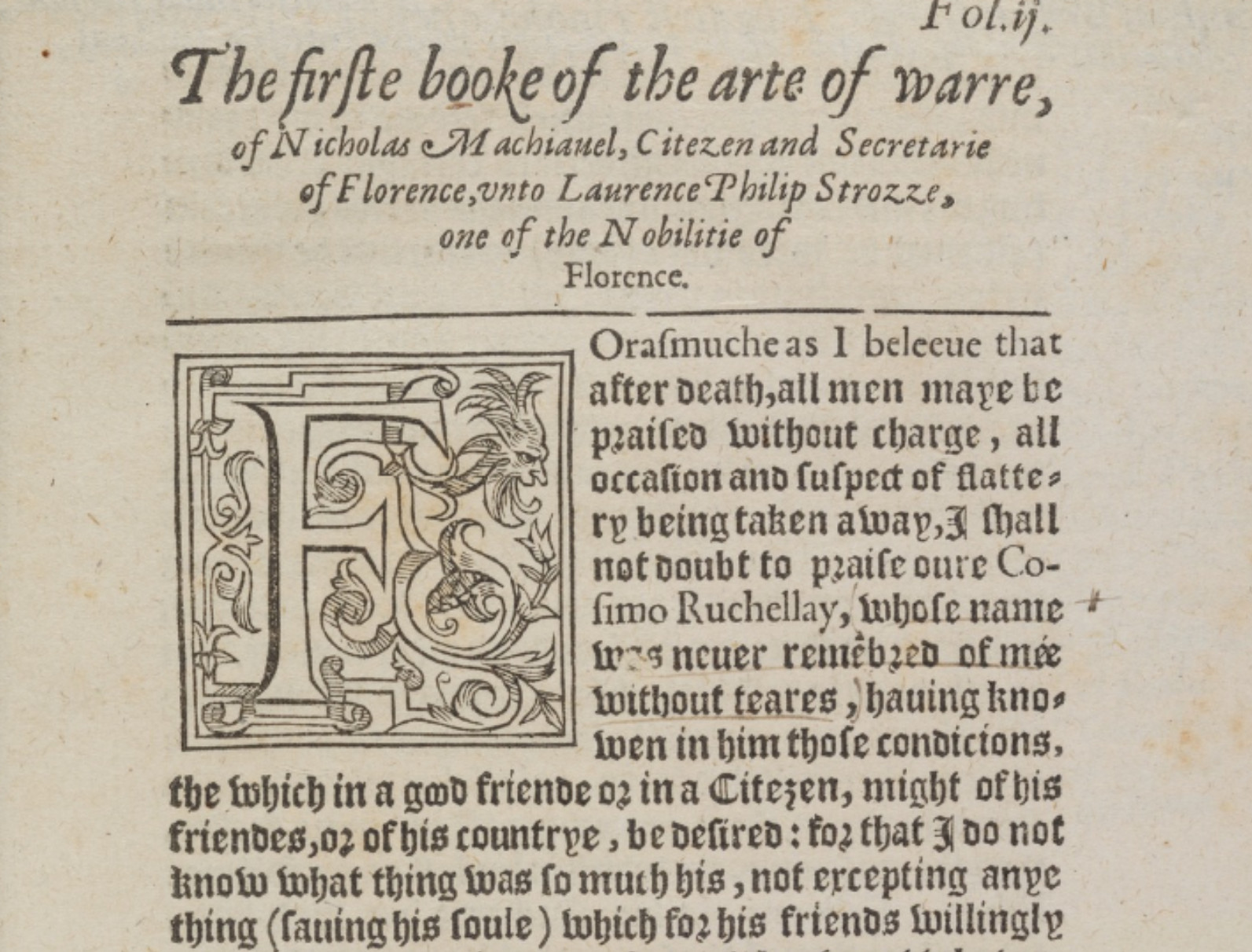
To acclimate them to rather alien fonts and to help prepare them for transcribing the Hamlet marginalia, I introduced my students to the AOR viewer. I asked them to practice transcribing sections of printed text from Machiavelli’s Arte of Warre (1573), which has a rather tricky font for those unaccustomed to looking at sixteenth-century books.
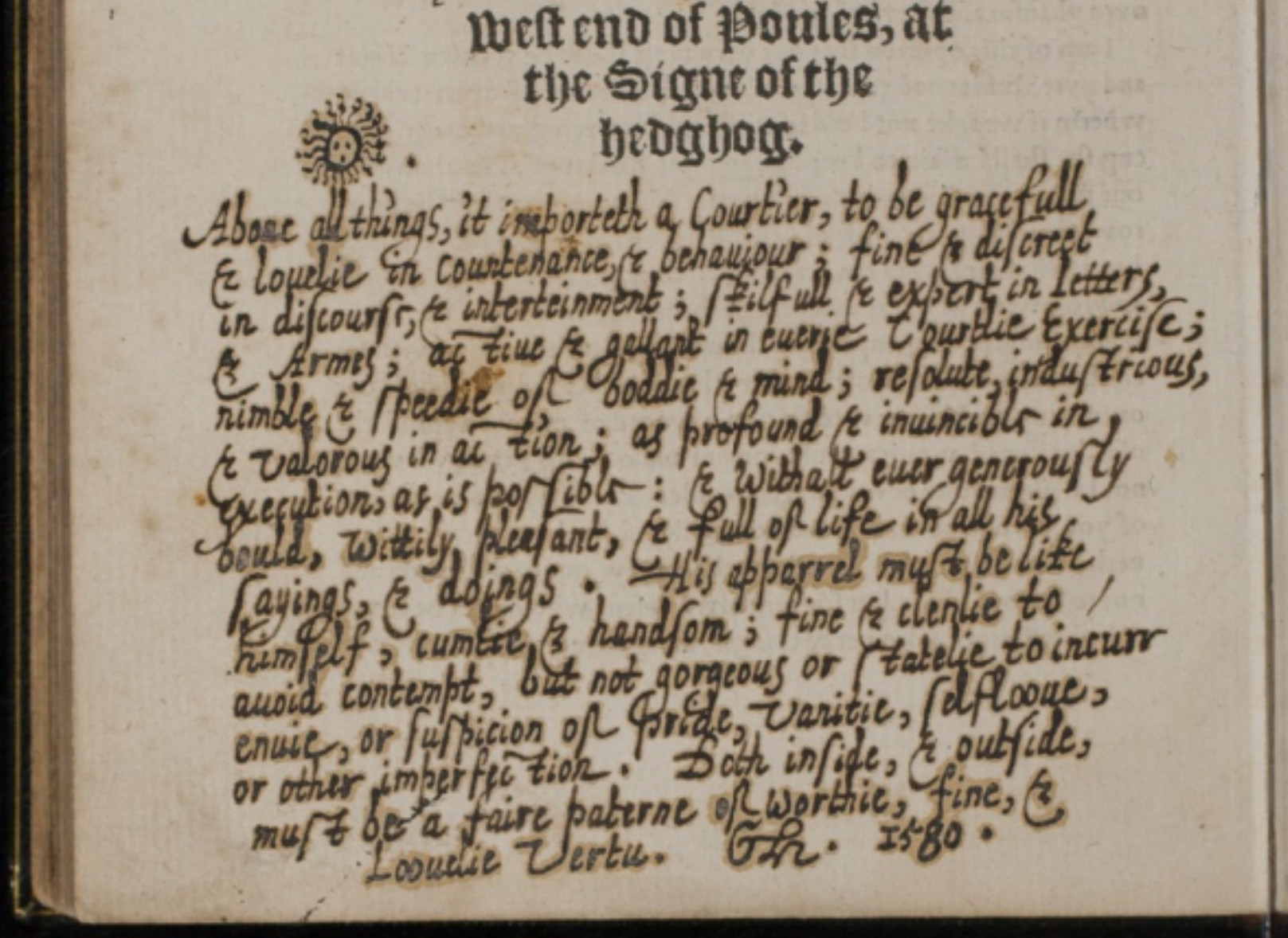
I then asked them to turn to Gabriel Harvey’s marginalia. We looked at one of his longer notes, found in an English translation of Castiglione’s The Courtyer (1561), which describes the ideal characteristics of a courtier. It also proved to be an interesting moment of comparison with the character of Hamlet, described by Ophelia as “the glass of fashion and the mould of form.”
After some practice in transcribing print and handwriting, I divided up the text into chunks of about 11 pages and assigned them to each of the students. I had eight students total, so this proved to be a very manageable division of labor. The marginalia themselves were also fairly straightforward:

Many of the notes—perhaps unsurprisingly for a stage manager—dealt with the entrances of characters, including where they might be positioned. In this instance, the ghost ought to be “under the stage.”

Yet modifications to the text, at least to this extent, was not something initially included in the development of the AOR transcription paradigm. Harvey and Dee, though often engaging actively with their reading material, are not particularly interested in correcting or changing the printed word to make it easier to perform. With Ward, there were several ways of “interacting” with the text:
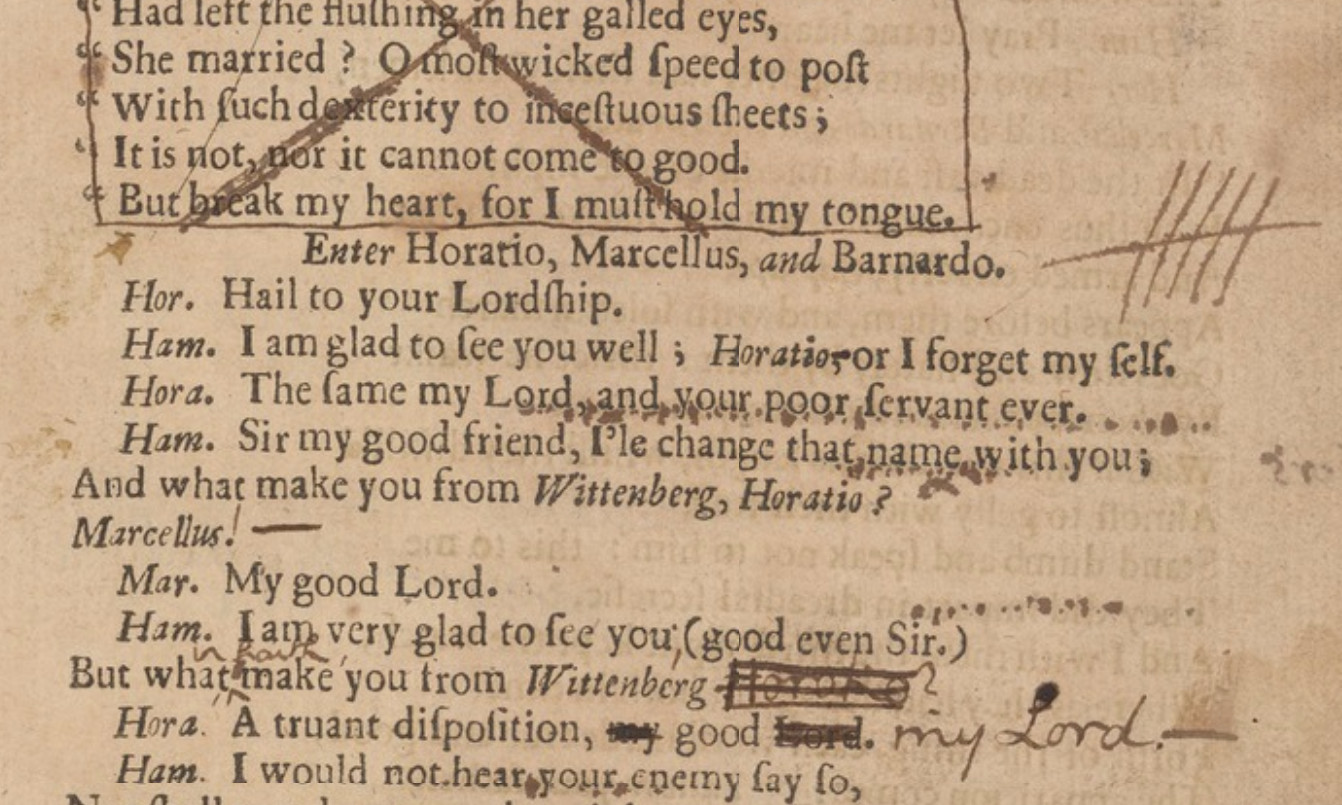
In this example we see several novel elements:

1.a large deletion of sections of text

2. a new symbol (looks like a long line with hatching)

3. the replacement of words and phrases (“my good lord” → “good my Lord”)

4. insertion of new elements, such as punctuation (ubiquitous in Ward’s promptbook)

To capture this information, I had to slightly modify our XML schema by incorporating a new tag and including a new symbol. This work was not particularly challenging, and our programmers were able to adapt to this different schema relatively easily.

To help the students in their transcriptions, almost all of whom had never worked with any sort of machine-readable language, I produced a simple transcriber’s manual (a pale imitation of the work done by Jaap and Matt for AOR). I also created a template XML file, which contained examples of the basic elements needed to transcribe a page of the Hamlet. All the students would have to do is copy, paste, and modify in order to capture the relevant information. These files, as well as the final XML files, were uploaded to a GitHub repository, which basically follows the same format as the AOR one.

Overall the students were quite invested in the work, although it took awhile to fall into a rhythm for accurately transcribing texts printed over three hundred years ago. We used class sessions as transcription workshops, where students were able to make use of laptops provided by the library. I was able to answer any questions the students had, and being together made it easier for them to check each others work.

Eventually the students produced XML files for the entire work, which can be found here, on a separate instance of the AOR viewer.

The interface is identical to that of AOR phase 1, although it is immediately clear that Ward’s style of annotation clearly functions much more differently than Harvey’s or Dee’s.

In addition to producing a tool for scholar’s to consult when researching early annotated editions of Hamlet, the students also stumbled across interesting elements in the text. For instance, one student found one of the earliest examples of an emendation to a particularly obscure passage in the play:

After doing some research, we discovered that Ward’s emendation (“hernshaw”) does not derive from any earlier editions of Hamlet but rather represents an attempt to clarify the ambiguous identity of “handsaw,” which is actually a bird and not a carpenter’s tool.

Another student focused on the interesting punctuation in Hamlet’s famous soliloquy in Act 3:
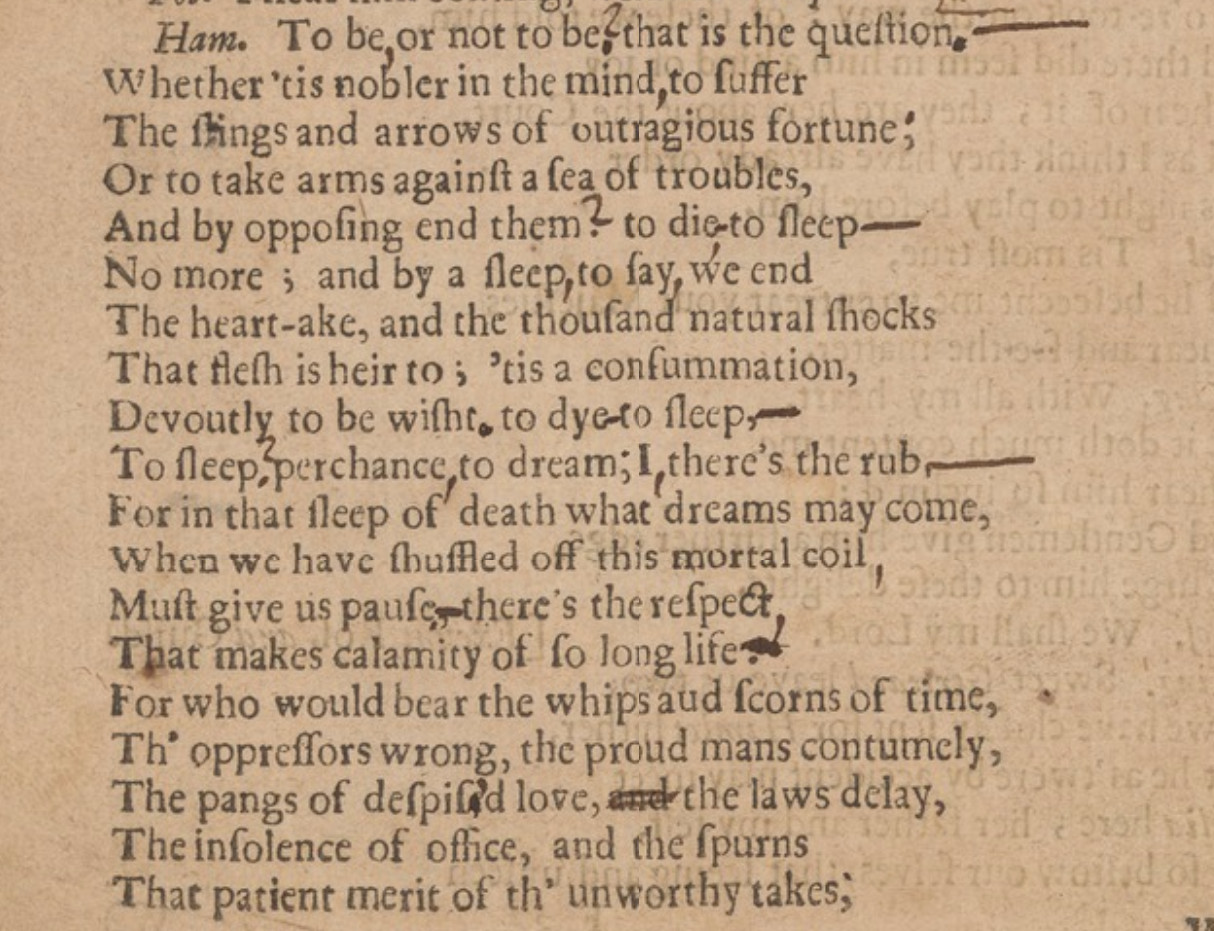
This student ultimately gave a fascinating presentation during a symposium in August on the different uses of punctuation in this very speech. Unsurprisingly, John Ward is relying on grammatical and theatrical conventions peculiar to his own epoch. I would say that the transcription process, however slow going it might have been, actually allowed the students to get much closer to the text than we had during our close reading of the play.

In addition to reading and transcribing Hamlet, we were also treated to a series of fantastic presentations from researchers at Hopkins working on AOR. Earle Havens introduced the class to the digital humanities and the use of digital tools for visualizing history, Jaap Geraerts skyped in from across the pond to talk about the process of developing AOR’s XML schema, Mark Patton described how programmers and humanists work together to make materials accessible to everyone, and Neil Weijer gave multiple presentations on early modern England, the history of the book, and Shakespearean forgeries.

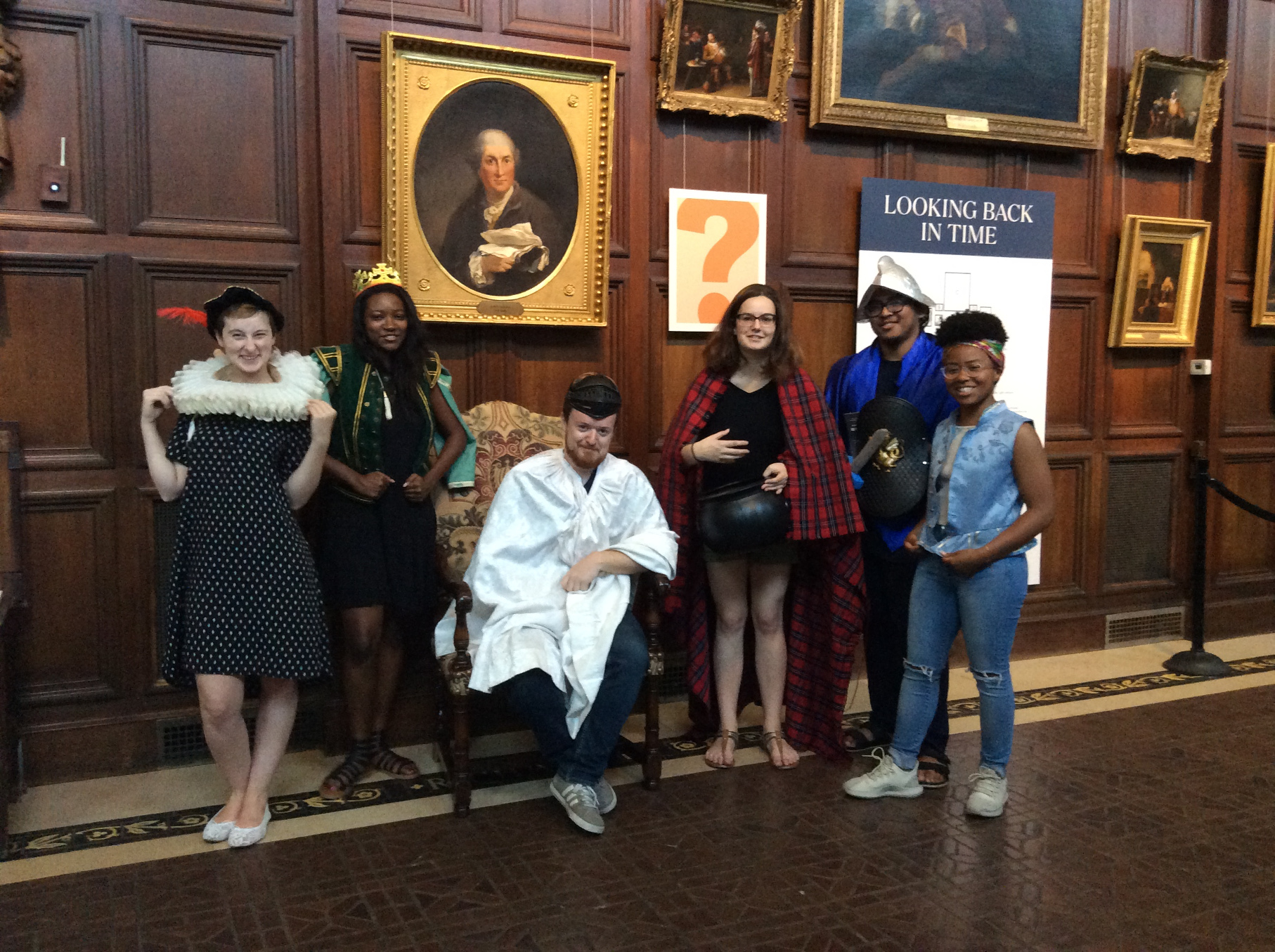
We also had the opportunity to go on several trips to visit various nearby labs and libraries to expose students to relevant and interesting research materials, as well as the many kinds of skilled professionals and scholars who work around them. We got to see some surgery performed on early modern book-binding structures in JHU’s Conservation Lab; we learned about print-making and early Shakespearean prints at the Baltimore Museum of Art; at the Evergreen Library, the students learned about the varieties of early books, including Audubon’s Birds of America in its enormous elephant folio edition. In the last week of class, we visited Washington D.C., where we went to the Library of Congress to see rare objects such as the first map containing America and Thomas Jefferson’s library. We also visited the Folger Shakespeare Library, where we were given a tour of the some of the library’s annotated Shakespeare texts. We also stopped by the ongoing exhibition on painting Shakespeare across time, an exhibit definitely worth seeing, especially since it lets you try on costumes:
The summer course turned out to be excellent research experience for the students, who were able to engage in more “traditional” methods, as well as explore and develop new types of digital scholarship. They were able to collectively explore the text of Hamlet at a high level of detail, learn about the history of the book (including the methods of early printing, typography, and printmaking), and develop an understanding of basic digital humanities tools, particularly the use of XML to help capture marginalia and textual modifications. AOR turned out to be a robust pedagogical tool. It immediately provided a platform for the easy exploration of early modern books, typography, and paloegraphy. More fundamentally, the process of producing a transcription for a new annotated book allowed students to develop new digital skills as well as hone their ability to carefully attend to the word on the page. Transcribing proved to be immensely useful in helping students both learn about the collective nature of research, as well as explore in a new way one of the most fascinating texts of English literature.
About Chris Geekie

History of Reading

The AOR2 Transcriber’s Manual is now available online!

Posted on: October 19, 2017 Jaap Geraerts Leave a comment

At the very beginning of the first phase of AOR (2014-2016), I started working on what would become the Transcriber’s Manual. Initially this document was intended to provide the research assistants with an overview of all the reader’s interventions thus far encountered and with guidelines for capturing these interventions in XML. Back then, the AOR XML schema still was under construction and subjected to frequent modifications. As a result, the Transcriber’s Manual became more than just a manual: it also turned into some sort of a log book in which we documented the decisions made in relation to the development of the XML schema. Therefore the Transcriber’s Manual not only is a useful reference work for those who are interested in the particular ways in which the AOR transcriptions are constructed, but also contains the rationale for our specific approach.

As AOR progressed and new books were digitized and transcribed, the Transcriber’s Manual steadily grew in size, making various internal reorganizations necessary. Due to the large number of high-res images, the document became so unwieldy that my old laptop would invariably crash when trying to amend and save it. Happily, the arrival of a new computer swiftly put an end to these problems. Since the start of AOR2, the Transcriber’s Manual has expanded even further. Moreover, due to the inclusion of several new reader’s interventions, we had to amend the ‘old’ AOR XML schema and created a new schema for phase 2 (2016-2018). Because we had always intended to design a fairly lightweight and flexible XML schema, we managed to include these new reader’s interventions without having to radically alter the structural features of the schema.

In order to document the evolution from AOR1 to AOR2, we decided to create a new version of the Transcriber’s Manual. The AOR2 Transcriber’s Manual still contains most of the content of the old Manual, but lots of new information based on the AOR2 corpus of books annotated by John Dee has been included, too. The dual nature of the Transcriber’s Manual is kept intact: just like its previous iteration the latest version of the Manual contains guidelines for the research assistants and well as an explanation of the decisions we made. Recently, in addition to the AOR1 Transcriber’s Manual, the AOR2 Transcriber’s Manual has been made available on the AOR site. Hopefully these documents are of any use to those who wish to gain a more fuller understanding of our working practices or who would like to embark on a project similar to AOR themselves.

P.S. Last but not least: the AOR2 Transcriber’s Manual contains sections with overviews of unknown/unidentified marks and symbols. Any input would be greatly appreciated!!

About Jaap Geraerts

History of Reading

John Dee’s Astronomicon and the Thirty-Six Decans

Posted on: September 21, 2017 Matt Beros Leave a comment

This blog post is written by another research assistant, Matt Beros. Matt is currently working on the first volume of Cicero’s Opera after just having finished transcribing Quintilian’s Institutionum oratoriarum!

———

In this post I will be briefly looking at some of John Dee’s astrological marginalia in UCL’s copy of Firmicus Maternus’ Astronomicon Libri VIII (1533). Dee appears to have revisited this work several times judging by the evident variations in handwriting style and quality of ink. The frontispiece is inscribed: ‘Ioannes Deeus 1550. 22 Maij Lovanij’ but many of the annotations are in the italic hand typical of Dee’s later writing style. Dee’s reference to a ‘blasing star’ in the constellation of Cassiopeia in 1582 provides us with an approximate terminus ad quem for his later annotations. The majority of the marginalia are in Latin and English with the occasional term in Greek and in one case Biblical Hebrew.

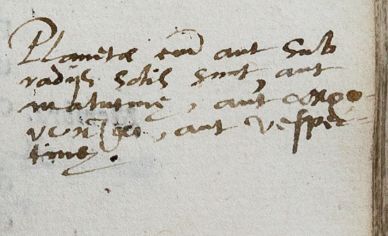
Many of the Greek astrological terms are difficult to identify since they often appear in the midst of a Latin marginal note. For example, in the following marginalia, the rather cryptic word following ‘solis sunt aut matutin[a]e, aut’ is the Greek astrological term: ‘ακρονυκτα’ (acronyctae).

‘Planeta[e] cu[m] aut sub radijs solis sunt, aut matutin[a]e, aut ακρονύκτα, aut vespertin[a]e.’

The planets as either under the rays of the sun, or as the morning star, or acronyctae, or as the evening star.

The term ακρονύκτα is a word from the Ptolemaic tradition referring to stars rising in the sunset. Numerous other astrological terms, such as κενοδρομία (kenodromia), literally ‘void of course’, occur in Dee’s marginal glosses throughout the Astronomicon. Porphyry of Tyre helpfully defines ‘kenodromia’ in his ‘Introduction to the Apotelesmatika of Ptolemy as when the moon is passing through a ‘void’ region in the zodiac.

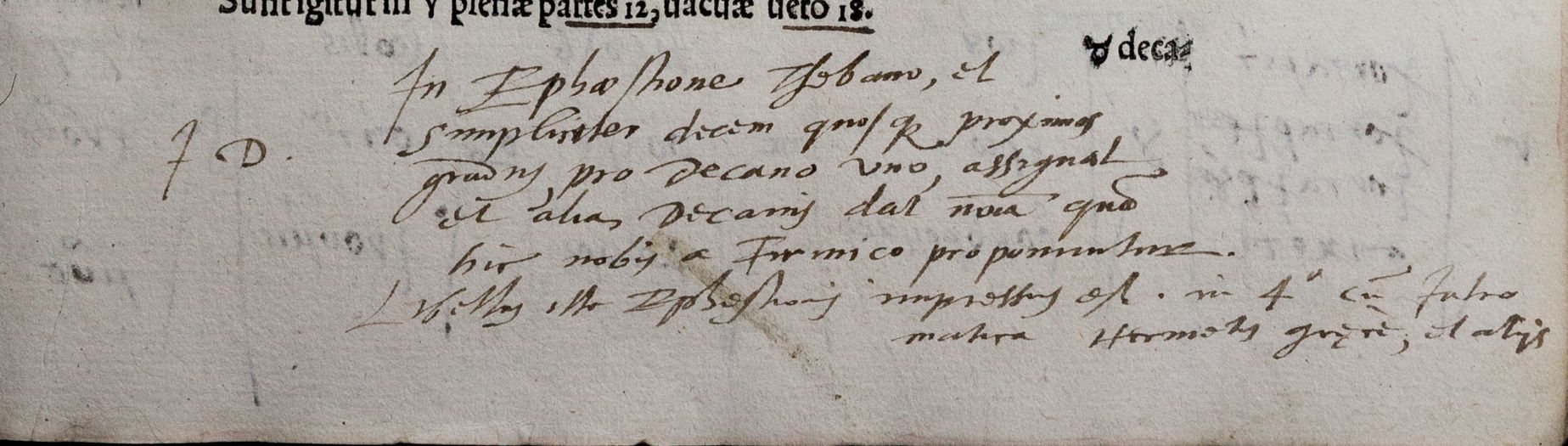
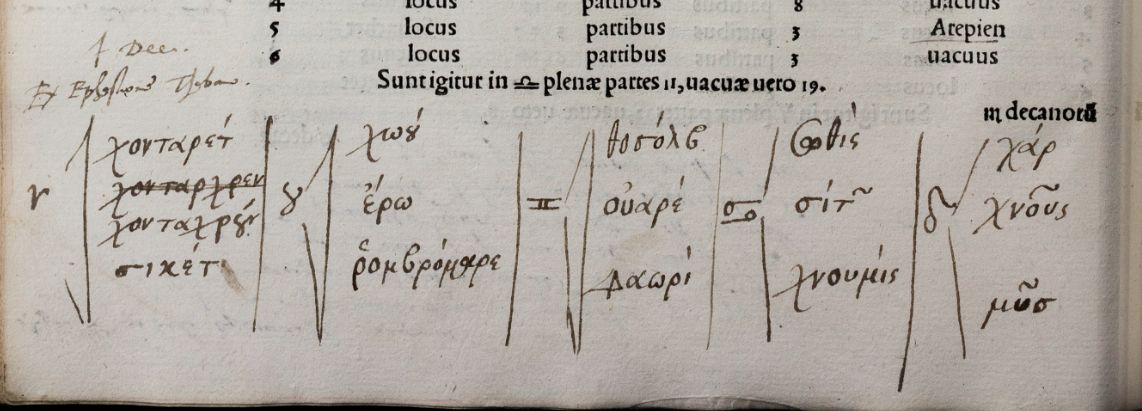
A more substantial example can be seen in Dee’s Greek annotations on the table of the thirty-six decans. The decans were Egyptian sidereal deities each associated with a zodiacal sign and closely related to the figure of Hermes Trismegistus. Maternus attributes this ‘most true and immutable theory’ to the Egyptian high priest Petosiris and the pharaoh Nechepso. In the margins of the text Dee scrupulously notes the equivalent Greek terms for each of the thirty-six decanal names listed in Maternus’ table. Beneath the table Dee writes, ‘J Dee. Ex Ephastione Thebano’ (from Hephaestion of Thebes). In another annotation Dee notes:

‘In Epha[e]stone Thebano, et simpliciter decem quosque proximos gradus, pro decano vno, assignat et alias decanis dat nomina quam hic nobis a Firmico proponuntur. Libellus ille Ephestionis impressus est. in 4˚ cu[m] Iatro matica Hermetis graere, et alijs’

Clearly Dee is citing another work as his source for the thirty-six decanal names from Hephaestion of Thebes. On the basis of this marginal annotation we know that this work by Hephaestion of Thebes is a ‘libellus’ (a small book or tract) collected in an anthology of Greek Hermetica (Hermetis graece, et alijs). Dee does not provide the title of this collection or the title of the libellus nor any publication date. We do know that this book is in ‘4˚’ (quarto) format and includes the title of another work beginning with ‘Intro[…]’. The title of this latter work was not immediately recognizable either. On the basis of Dee’s handwritten catalogues we know that he arranged many of his books by format. The detailed citation suggests that this is possibly a book from Dee’s personal library. Whilst perusing Dee’s 1583 autograph catalogue under ‘libri in 4˚’, the following title caught my attention: Joachim Camerarius’ Astrologica. Qua[e]da[m] opuscula gra[e]re 4˚ Nori[m]bergae (1532).

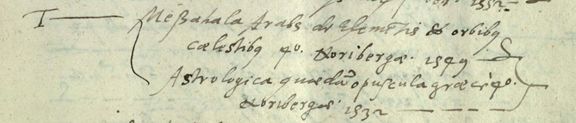
Camerarius was a German classical scholar who published the first Greek edition of Ptolemy’s astrological text, Tetrabiblos in 1535. The Astrologica was a slightly earlier anthology of Hermetic astrological tracts in Greek with selected works translated in Latin. Dee’s own copy of the Astrologica is bound with the Arabic astrological work, Messsahala de elementis et orbibus coelestibus (1549) and currently housed at the Bodleian library, Oxford. Camerarius’ anthology collected Hephaesiton of Thebes’ Ἀποτελεσματικά, Vettius Valens’ Florilegium and the Ίατρομαθηματικά ascribed to Hermes Trismegistus. The final work, Ίατρομαθηματικά is Latinized as ‘Iatromathematica’. Now we are in a position to transcribe the second title listed in Dee’s marginal annotation as ‘Iatro[mathe]matica’. If we closely examine the Ἀποτελεσματικά (Apotelesmatika) of Hephaestion of Thebes, we can see that Dee appears to have written the decanal names verbatim including the precise same Greek contractions as the Camerarius edition. This is fairly compelling evidence that Dee had Camerarius’ anthology close at hand while he was annotating his copy of the Astronomicon. Dee also adds an additional column to Maternus’ table under the title ‘grad[us]’ (degree). Dee’s column is simply the cumulative sum of each preceding degree of separation between the decanal positions in the zodiac. In other words, it indicates the position of each decan in the zodiac for each sign between 1˚-30˚.

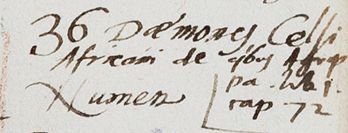
Two other interesting marginal notes cite additional sources for the decanal names. One marginal note references the thirty-six daemons of Celsus Africanus and another notes the thirty-six horoscopes in the Asclepius, a tract from the Corpus Hermeticum. Dee provides a detailed citation for Celsus Africanus’ discussion of the 36 daemons in Heinrich Cornelius Agrippa’s De Occulta Philosophia Libri Tres.

’36 Da[e]mones Celsi Africani de q[ui]bus Agrippa. lib[er] 1. cap. 73.’

36 demons of Celsus Africanus from which Agrippa cites in Book 1, Chapter 71.

Agrippa’s work had a notable influence on Dee, his September 1583 catalogue housed at the British library (Harley MS 1879) lists three different editions of De Occulta Philosophia (fols. 39, 44v , 53v). The Celsus Africanus passage in Agrippa describes the decanal names as referring to daemons which were believed to exercise an influence over corresponding parts of the body. Finally, Dee also cross-references another source of the thirty-six decans in the dialogue of Asclepius, a work that was enjoying renewed attention in the early modern period following Marsilio Ficino’s publication of the Corpus Hermeticum in 1471.

Maternus ascribes an ancient Pharonic origin for the thirty-six decanal names but the transmission of these terms through various Graeco-Egyptian sources is far from straightforward. As William Sherman points out, “Dee often pairs the terms ‘ancient’ and ‘credible’ but he also had an awareness that the older the information the greater the need for careful scholarship, particularly in terms of textual transmission.” Dee’s marginalia on the decanal names is an interesting example of his reading practice of comparing and collating different texts from his library. Such marginal notes attest to Dee’s philological interest in the Ptolemaic astrological tradition and his scholarly caution in comparing variant textual sources.

About Matt Beros

History of Reading

Dee’s Historical Comparisons & the Mystery of ‘Liber Gallicus’

Posted on: August 29, 2017 Daisy Owens Leave a comment

This blog is written by Daisy Owens, one of the three Research Assistants working on AOR.

——————

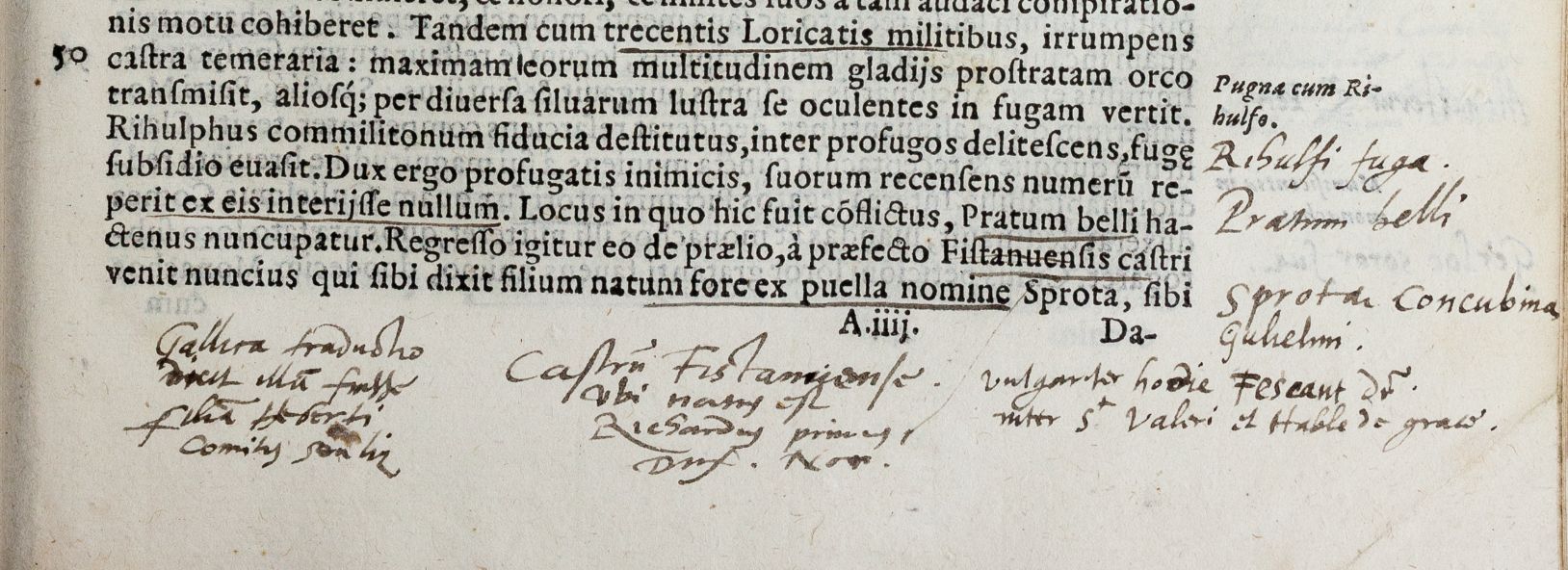
John Dee frequently refers to other books within his own collection in his marginal annotations, and by tracing these external references we can attempt to build up a picture of both how Dee read the books in his library and the connections he saw between certain texts. In his copy of Thomas Walsingham’s Ypodigma Neustriae, he unsurprisingly makes connections between this text and another historical text by Walsingham, the Historia Brevis, which is bound together in the same book. However, Dee’s most frequent external reference within his annotations of Ypodigma Neustriae are to a book which remains elusive to me, the mysterious ‘liber gallicus’.

Thomas Walsingham, Ypodigma Neustriae, p. 20.

Dee makes seven allusions to a certain ‘liber gallicus’, as well as two mentions of a ‘traductio gallica’ which may refer to the same text, over a twenty page-section of Walsingham’s text approximately covering the period 933 to 1037 in the history of Normandy. These repeated references to the ‘French book’ contrast with his other connections between texts in a number of ways. Whilst in most of his external references Dee names the author, here no such helpful information is given. Even the name ‘liber gallicus’ stands out as an unlikely actual title, a feeling compounded by the fact that it always appears here uncapitalised. Though we can only speculate about the reasons behind this apparent lack of detail, the sustained comparison with Walsingham’s history suggest that this was a book of some importance to Dee.

Thomas Walsingham, Ypodigma Neustriae, p. 25.

Whilst some of these references simply note ‘liber gallicus’ next to part of the printed text or Dee’s own marginalia, perhaps indicating that a particular historical episode or figure is also recorded in the French book, on occasion they appear to allude to extra information supplied in ‘liber gallicus’, or even to differences between the two texts. Beneath a reference to Sprota, the mother of Richard I of Normandy, Dee notes in Latin that ‘the French translation says that she was the daughter of Herbert, Count of Senlis’. Where Walsingham names the daughter of Duke Hugh the Great as Emma, Dee states that the French translation calls her Anina or Agnet. Whilst elsewhere Dee corrects errors in both content and grammar, marking out key passages in his copies of texts such as De Navigatione and Historie del S. D. Fernando Colombo with an approving ‘hoc verum’ or ‘verè’, interestingly here he does not indicate whether he feels one book is more reliable than the other. Judging from these annotations, he appears to value the comparison of a variety of texts, and here seems reluctant to wholeheartedly pledge allegiance to either of the accounts.

Thomas Walsingham, Ypodigma Neustriae, p. 7.

Pinning down the identity of the work Dee repeatedly references should have been simple due to the specificity of the references: I was, after all, searching for a book about a particular one hundred-year period of Norman history featuring some fairly obscure figures. However, unfortunately the precision of the historical moment was matched by the vagueness of Dee’s authorless ‘liber gallicus’ tag. After some investigation, I lined up Matthew of Paris’ Chronica Majora as a possible contender; sadly my hopes were dashed when the content of the two texts failed to correspond. I also remained preoccupied with Dee’s uncharacteristic failure to give the author’s name…

Although the identity of ‘liber gallicus’ remains a mystery to me at present, the study of Dee’s references to other texts here and elsewhere in his library opens up a number of lines of enquiry regarding his approach to the study of history and to learning and reading more broadly. Drawing on these connections, we can begin to piece together a more detailed picture of Dee’s tentative but rigorous approach to history involving a comparison of multiple texts.

About Daisy Owens

Case Studies, History of Reading

Dee and his books

Posted on: July 31, 2017 Finn Schulze-Feldmann Leave a comment

Summer or not, we are slaving away at the CELL office in order to transcribe all the annotations contained in the books which are part of our Dee corpus! This blog post, by Finn Schulze-Feldmann, one of the three research assistants involved in phase 2 of AOR, reflects on Dee’s different annotation styles.

—

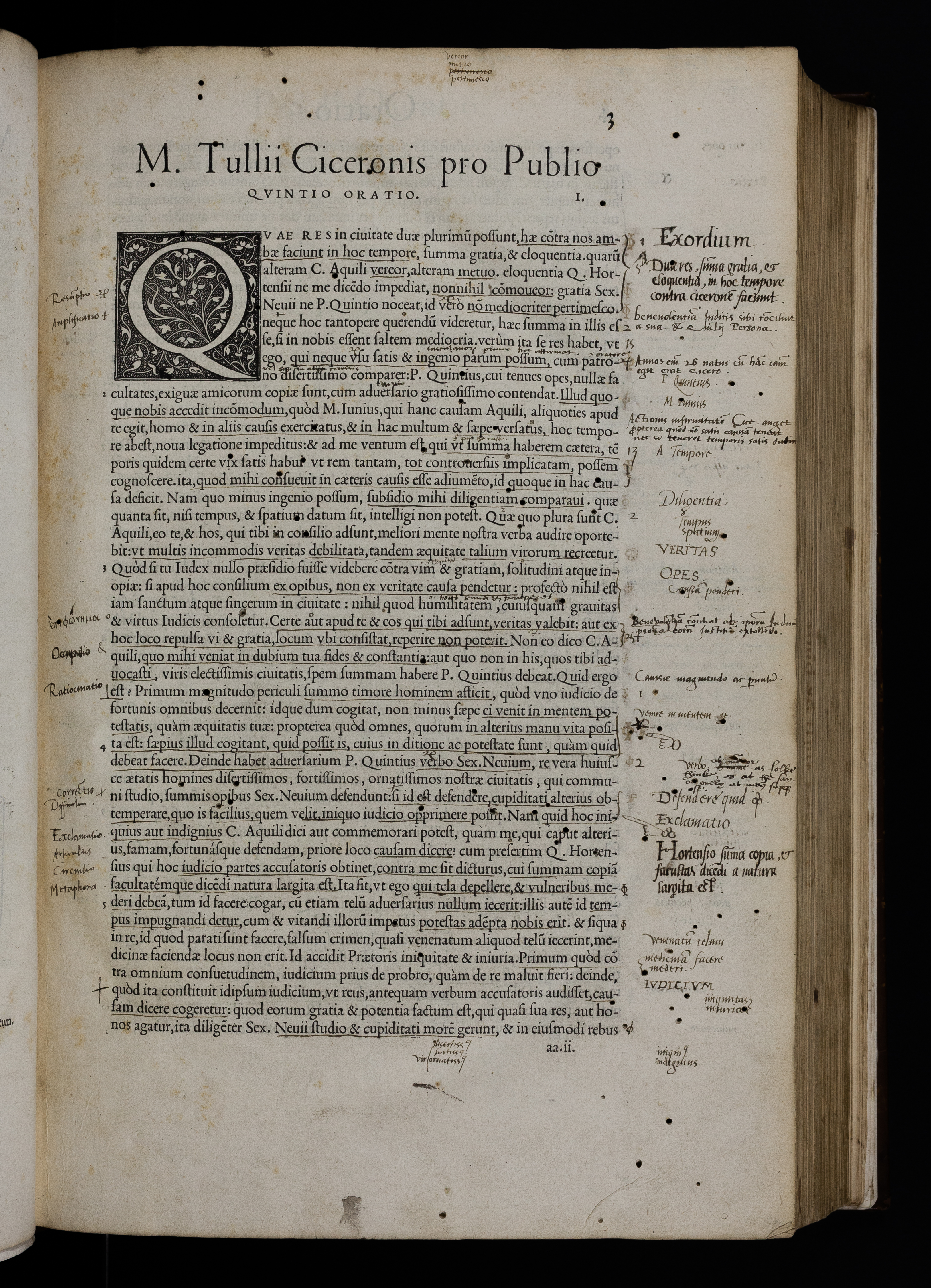
When transcribing John Dee’s marginal notes, one comes across many different styles of how to annotate a book. We all know some who consider books to be so sacred that their immaculacy shall not be tainted under any circumstances, and others who quite willingly leave their individual imprint on a book, scribbling their thoughts on the margin and highlighting passages in all the colours of the rainbow. If Dee had had different colour options available too, he would most certainly used them. His copy of Cicero’s Pro Publio Quinctio is at first sight slightly overwhelming to say the least. There are plenty of comments in the margins, heavy underscoring and various different drawings and symbols. Hardly any pages are left untouched. Thanks to these annotations we are able to gather some understanding of how a scholar as prolific as Dee worked.

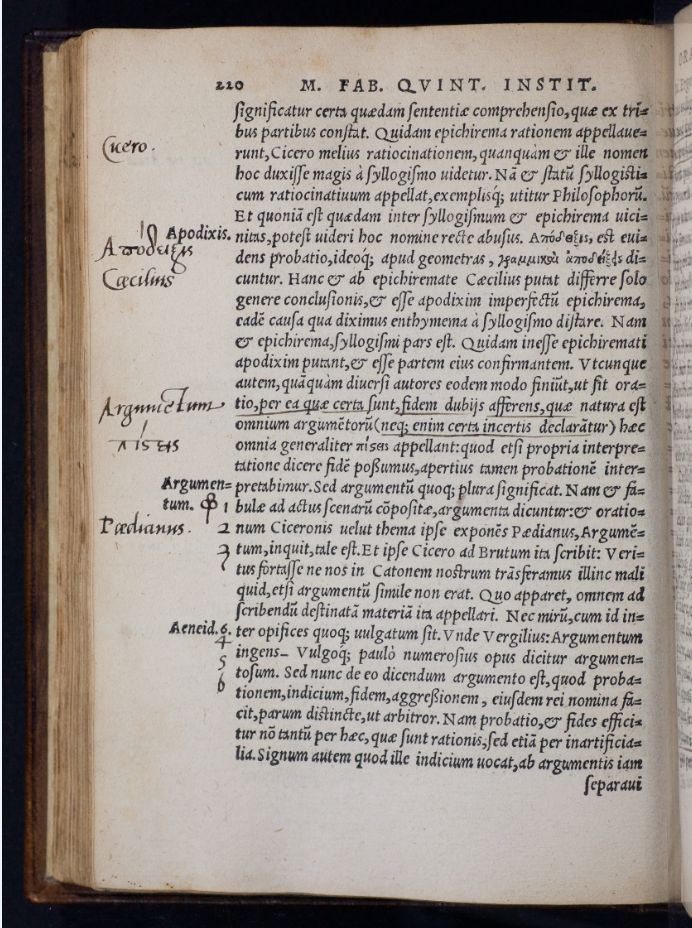
This is, of course, not to say that Dee subjected all his books to such excessive treatment. Quite the opposite! His copy of Quintilian’s Institutio oratoria could serve as an example in any modern-day handbook on how to read, highlight and annotate texts. Measured and never in a way that the reader could not grasp them immediately, the annotations are a guide through the text – and a delight for those transcribing them. They reference other works of Cicero, number lists mentioned in the text and provide brief summaries. Thus, to navigate through the text is made an easy task.

And then there is a third kind of annotations. Scattered through all his books, there are some that might be of interest not so much for their scholarly purposes, but rather they allows us to get closer to John Dee the person, or shall I say, the artist? Dee used not only to annotate books, but also to draw in books. Admittedly, the majority of his drawings mark names in genealogical trees as kings or queens. But there are also the odd ones that are a bit more playful. One of my personal favourites is a face that is seemingly randomly drawn in a margin of Dee’s copy of Matthew Paris’s Flores historiarum.

Their entertaining effect aside, the different ways in which Dee annotated his books do pose questions regarding their purpose and use. Would anyone but Dee be able to make sense of his densely annotated Cicero volumes? They seem to contain different layers of annotations. Those in a neat hand would still help a modern-day reader to find their way around the text. Others such as notes confirming or rejecting what is written and references to other works bear valuable insight in Dee’s intellectual engagement with the text. Especially the Cicero mentioned above appears to be a book he had read over and over again, each time with another focus. A rich repository for generations of researchers to come, none of Dee’s contemporary, I suspect, would have benefited much from these. As the printed text itself is at times even obscured by the marginalia, this volume seems dedicated to private study alone. In contrast, it would not be much of a surprise if the well-measured and neatly written notes in the Quintilian were indeed intended to be read by others. They are instructive and insightful. That Dee had allowed himself a little digression by drawing random faces and crowns, readers both today and in the past may smilingly excuse.

About Finn Schulze-Feldmann

History of Reading

AOR on tour II: scholarly tourism in Poland

Posted on: June 29, 2017 Jaap Geraerts Leave a comment

I have always been a big fan of the Dutch expression ‘het nuttige met het aangename verenigen’, that is, to combine or unite the useful with the pleasant (in Dutch – a superior and more elegant language 😉 – it sounds far less clunky). Recently several members of the AOR team spent a perfect week in Poland, and we managed to achieve just that! The week started with a two-day colloquium, titled ‘Libraries, Scholarship, & Science at the Crossroads, from Nicholas Copernicus to John Dee, 1490-1610’. A large variety of topics were addressed in the papers presented at this conference, ranging from the (alchemical) writings of Edward Kelly, astronomical works heavily annotated by Joannes Broscius and Peter Crüger, and Dee as a reader of Antoine Mizauld, to Copernicus’ annotations, the ‘history of the history of writing’, and the design of printed books in the sixteenth century (for those interested, the whole programme can be found here). We also fulfilled our scholarly duty by giving papers on several aspects of AOR: Earle started with a lucid overview of AOR; Matt focused on the data aspects of AOR, discussing the ways in which we handle and view our own data; Chris presented a compelling approach to a particular element of the AOR data, the people mentioned in Harvey’s marginal notes, and gave numerous examples of how we can use network visualization in order to make sense of this data (Chris will write a separate blog post on this topic in due course); I focused on Dee’s copy of Cardano’s Libelli Quinque and compared his annotations to those of Harvey in another astronomical text, Luca Gaurico’s Tractatus astrologicus.

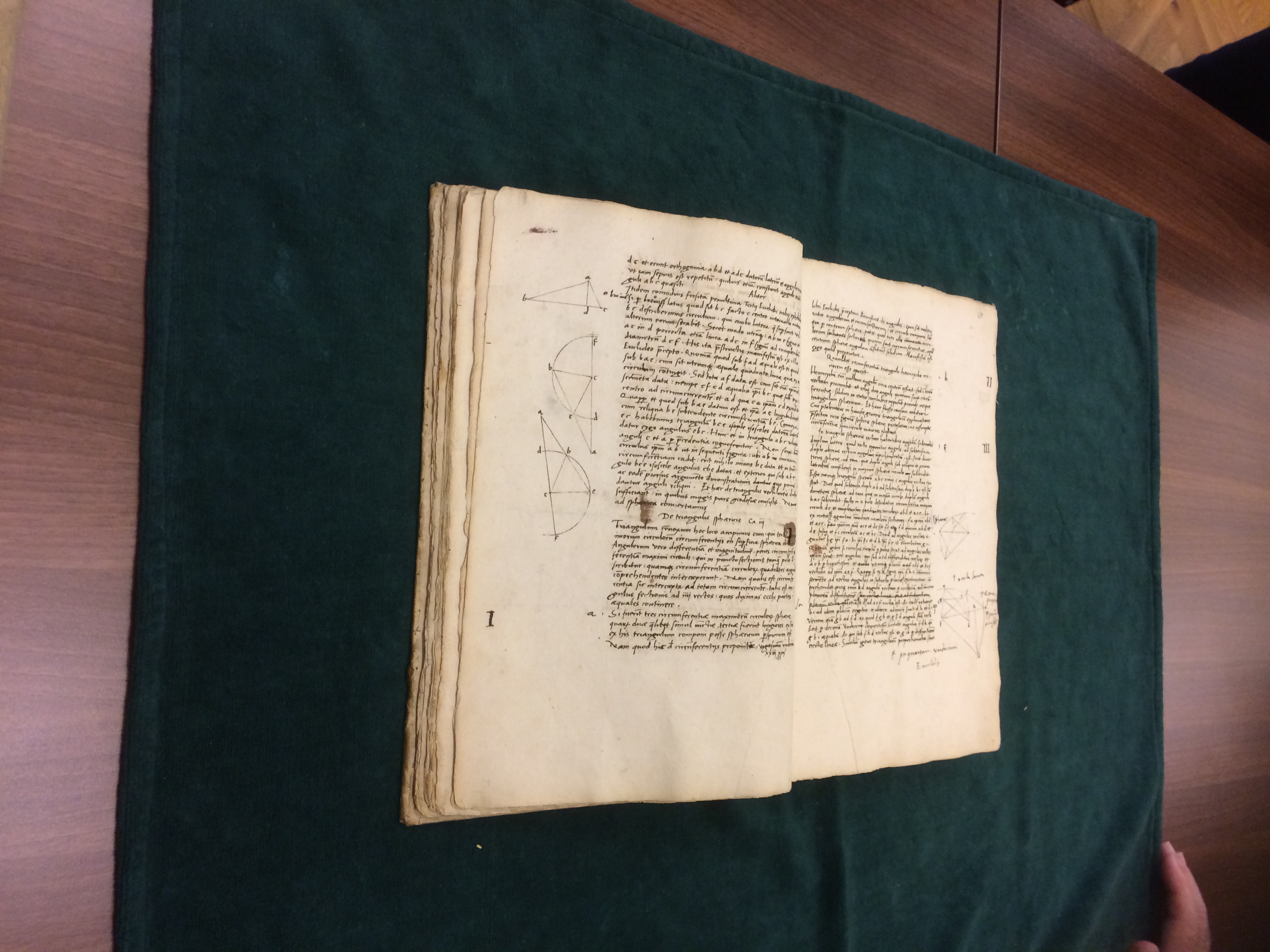
Several trips to various libraries in Cracow were included in the conference programme and this, together with the copious meals and the good company, proved to be the really pleasant aspect of this week. It turned out that most libraries in Poland, or at least those in Cracow and Wroclaw, have amazing collections, many of which are not well known outside (and in some case even inside) Poland, and true treasures are just waiting there to be discovered! During the days after the colloquium the scholarly tourism continued: on Wednesday we visited the Jagiellonian Library and saw (and touched!) the autograph of Copernicus’ De Revolutionibus (some low-res images can be viewed here).

In the afternoon we had the pleasure of going to Collegium Maius, the museum of the Jagiellonian University, where we encountered an actual bookwheel!

© Clarinda Calma

On Thursday we travelled up to Wroclaw to visit the University Library, which turned out to be truly extraordinary as one of the librarians had found, when she was preparing the show and tell, a presentation copy of Tycho Brahe’s De mundi aetherei to Johannes Praetorius! [insert image]. If this wasn’t enough still, that afternoon we went to yet another library in Wroclaw, the Ossolineum.

All in all, this was an amazing week and a wonderful combination of scholarship, bibliophilism, good company, and let’s say a more than sufficient quantity of excellent food and wine, beer, and spirits. It also proved to be a great way to get to know Poland, and many people, including myself, sort of fell in love with this country. We would like to express our heartfelt gratitude to all the people and institutions who made this week possible, in particular Clarinda Clama, who did a marvellous job organizing this week!

About Jaap Geraerts

History of Reading

AOR on tour

Posted on: June 16, 2017 Jaap Geraerts Leave a comment

As the conference season has started in earnest, various members of the AOR team have travelled across the globe in order to preach the AOR-gospel. Here are some updates on the various conferences at which we presented!

RSA 2017

As part of a now firmly established ritual, several members of the AOR team (Chris, Earle, Jaap, Matt, and Tony) took part in a round table discussion on AOR titled ‘Reading John Dee’s Marginalia: Expanding the Archaeology of Reading in Early Modern Europe’. As the title indicates, the round table aimed at discussing the new avenues into which AOR is moving due to the inclusion of a second reader, the Elizabethan polymath John Dee. Tony started with a wonderful comparison of various differences and similarities between Harvey and Dee as annotators and readers, while Matt zoomed in on a particular difference, namely Harvey’s and Dee’s diverging approaches to and use of annotations. The comparison between Harvey and Dee was fleshed out even more by Chris, who compared the use of the Greek language in the annotations of both readers. Earle presented a compelling overview of AOR and explained how the new directions into which AOR is moving form a logical extension of the first phase of AOR; Jaap offered an overview of some challenging new types of annotations the Dee corpus includes. All in all, it was a lively session in which we discussed the humanistic and technical developments of AOR and had a stimulating discussion with the audience about the content of the annotations themselves as well as the best way of making them available in digital form in the AOR research environment.

CNI 2017 Spring meeting

Members of the AOR team regularly attend and present at the meetings organised by the Coalition for Networked Information (CNI), which primarily caters for an audience comprising librarians, data curators and digital archivists. These meetings, which occur twice a year, are a perfect platform for our colleagues at JHU’s Digital Research and Curation Centre to provide information about the technical (infrastructural) aspects of AOR and related projects they are working on. It also has become sort of a tradition to present a paper which combines the humanistic and technical strands of AOR. Following up on an earlier paper Sayeed and I gave at CNI’s Fall Meeting 2015 in Washington D.C., we now embarked on a trip to Albuquerque. Whereas previous time we talked about the particular model of development the AOR team has adopted, ensuring the continuous close cooperation between team members with technical and those with humanistic backgrounds, in this presentation we focused on some of the new directions into which AOR is moving, largely due to the inclusion of a second reader, John Dee, and his particular reading and annotation practices, as well as the development of new use cases and the aim to enhance and expand the functionalities of the digital research environment AOR envisages.

Dee’s technical annotations, such as astronomical charts, genealogical trees, and tables filled with all kinds of data, do not only pose challenges to the XML schema, but also force us to think about the appearance of what we now would call “structured data” in his annotations. We need to think how to capture and, possibly, reconstruct the relationships between the component parts of the data Dee recorded in his marginal notes. Of particular importance is the way in which we conceptualise such ‘reader interventions’, but also how such interventions are made accessible in the AOR viewer. As such, Dee’s annotations further the development of both the humanistic and technical strands of the project. Hereafter, Sayeed presented his vision of the development of infrastructure and how infrastructure can be shared among DH projects, benefitting from similarities between projects while maintaining their integrity as projects with particular research questions, sources, aims, et cetera. He then moved on to showing how some of the AOR data can be linked to other, external datasets, thus enriching the AOR data with the data generated by other (DH) initiatives. We did address other topics in our presentation and, luckily, CNI has been so kind to record it! You can view it here!

Shakespeare Association of America

While Jaap headed to Albuquerque, Matt was on his way to Atlanta for the meeting of the Shakespeare Association of America (or #shakeass, which is surely up there in the catchy hashtag stakes). SAA is organised slightly differently to most other “big” conferences: most of the meeting is given over to seminars, rather than panels, and the focus is on working together in discussion on specific themes and issues. Matt had been invited to take part in a seminar called “Traces of Reading in Shakespeare’s Britain”, organised by Rebecca Munson (of AOR Project Partner Princeton University Centre for Digital Humanities) and Philip S. Palmer (Head of Research Services at UCLA’s wonderful William Andrews Clark Memorial Library). It was especially good to get a chance to swap notes with Erin McCarthy of NUI Galway’s brilliant project The Reception and Circulation of Early Modern Women’s Writing (RECIRC). The seminar benefitted from commentary from Heidi Hackel of UC Riverside, whose Reading Material in Early Modern England (CUP, 2005) is absolutely required reading for students of annotation (and offers an intellectual approach quite different from our own here at AOR, but that’s a subject for another blog entry.)

About Jaap Geraerts

History of Reading

Talking data

Posted on: March 13, 2017 Jaap Geraerts Leave a comment

Over the last decade or so, it has become commonplace to talk about data sets in relation to humanistic research. Whereas data sets seemed to be intrinsically linked to and part of the natural sciences, humanists of various plumage now regularly create their own. Increasingly, humanities data sets do not only contain quantitative data, such as the information amassed by economic historians, but qualitative data as well. The very process of capturing qualitative data enables scholars to study particular historical phenomena from a quantitative perspective too. Yet, I would argue, the availability of quantitative data should not replace our more ‘traditional’ methodologies which are so finely attuned to studying and understanding qualitative phenomena.

For even when qualitative information becomes quantifiable, we should not discard the richness and depth of qualitative sources; it would make little sense to conflate the fluctuations in interests rates in the early modern period with the number of times wills of early modern Catholics did or did not invoke Christ, Mary, and the saints. Even though both phenomenon are quantifiable and can be expressed in numbers, these numbers reveal entirely different dimensions of the historical past. Nor would it make sense to present the number of times poets like Joost van den Vondel or Shakespeare used the word ‘mother’ in one of their plays as a fact as such – for what does it tell us? The use and meaning of the word mother only can be grasped when taking into account various factors, including the syntax of the sentence, the meaning of other words which surround this word, and stylistic conventions. Having said that, quantitative approaches to primary historical sources of whatever kind can be very useful; ultimately, such approaches enable us to discern patterns that are not immediately obvious. Such patterns are often difficult to detect in traditional, analogue research environments. Yet the detection of such patterns should facilitate a movement ad fontes, offering a new perspective through which we can view and study our cherished primary sources. Indeed, we should strive to marry qualitative and quantitative analyses, opening up new dimensions and raising new research questions that are difficult to conceive of and pursue outside digital environments.

How does our own data set relate to all of the above? Twice during the first phase of AOR (2014–6) we numerically broke down our data set, both in relation to the creation of internal reports for our funder, the Mellon foundation. Both documents can be found here and here. One of the things we immediately realised when analysing the AOR data set is its small size: currently, even now work on the AOR2 corpus already has commenced, all the XML transcriptions amount to less than 40 megabytes. This certainly is not the size which enables one to boldly walk into a conference room to shout “my data set is bigger than yours”. (As a note on the side, humanists should refrain from doing this anyway, since the data sets of virtually everyone working outside the humanities are larger than ours.) Although size matters to a certain extent (in our case: the larger the data set, the more transcriptions it includes, and the more users will be able to find and discover), what really matters is the actual data of which a data set consists and the way in which it is captured and structured, for this determines the ways in which we can interrogate our data and what we can get out of it.

The structure of our data reflect the various types of reader interventions we encountered in the books in our corpus, such as marginal annotations, symbols, marks, drawings, tables, and graphs. This division, which closely mirrors the actual annotations practices of the readers on which we focus, makes it possible for our users to search within and across reader interventions. The AOR search widget, the child of the heroic efforts of our programmers Mark Patton and John Abrahams, contains an advanced search functionality which makes it possible to create complex, query-based searches, a powerful way of interrogating the AOR data. The juxtaposition of AOR data (the transcriptions as well as the search results) to the digital surrogates of the annotated books, facilitates an easy and intuitive movement ad fontes. In such a way, we can reap the fruits of working with humanities data while having the primary sources (or their digital surrogates) ready at hand.

Another way in which we can approach and, in a way, dissect our data set is through statistical analysis. Our thinking about the application of such an analysis started with rather mundane questions such as: “if Harvey mentions Caesar in a marginal note, which other words do frequently appear next to it?” In order to streamline such an analysis, we decided to formulate a number of concepts groups, thematic groups which include words which relate to the same, often rather broad theme, such as war, king/kingship, mind, soul, body, action, et cetera (Harvey’s own system of astrological symbols, which denote more abstract concepts, was actually really helpful in designing these concept groups). The concepts groups consists of words which together appear with a certain frequency (in order to yield statistically significant results) and include (equivalent) words of the two languages which dominate Harvey’s marginal notes, Latin and English. In generating these groups, we could make use of the lists with words and the frequency with which they appear, which are part of our recurrent data releases.

Although the formulation of concept groups was within our power, we quickly realized that none of us master the specialist knowledge and skills to actually subject our data to rigorous statistical analysis. Hence we decided to employ some professional statisticians. Once the data was made ready for analysis, an interesting process in itself which I will address in a separate blog, the statisticians started their work in earnest, mainly aiming to see whether there are any statistically significant correlations between concepts groups. In order words, do we see words which are, for example, part of the concept group ‘mind’, often appearing with words which belong to the concept group ‘body’? This makes it possible to discern links between certain topics Harvey addressed throughout his marginal notes. Although at this point in time the results of the statistical analysis are tentative, partly because our data set is slightly lopsided due to books which focus on war and strategy (Livy, Frontinus, and Machiavelli), the insights one can gain by a statistical approach are already evident. Throughout AOR2 we will continue applying statistical analysis to our data, making use of the inclusion of the second reader, John Dee. As we envisaged, results from the data analysis, even when only partial, immediately forces one to go back to the primary sources: even if there is a correlation between one or more concept groups, the individual instances of this correlation need to be tracked down and studied within the larger context of a marginal note or a set of marginal notes on a page in a particular book.

Lastly, interesting things can be done when relating or connecting our data set to other existing data sets that float around on the web. So far many data sets exist on their own, rather isolated from their peers. Over the last couple of years, the concept of Linked Open Data has rapidly become popular, as a motley crew of people comprising web architects, data curators, scholars, and scientists feel the need to link their data to that of others. This is not always a straightforward process at all, and in the future a separate blog will be devoted to it. Regardless of the challenges, the possibilities of linked data have captivated the mind of the AOR team. Already during AOR1 we realised that readers were often moving outward, for instance by referring to other books, some of which are not in our digitized corpus or are simply no longer extant. Moreover, some of our books are classical, canonical texts, such as Livy’s History of Rome, and digital editions, including translations, exist (Perseus), and it would be neat to see whether we can directly link to these editions. The concept of Linked Open Data also influences our thinking about the way we capture our data: how to transcribe the astronomical data in the Dee annotations in such a manner that it facilities an easy exchange with already existing astronomical data sets? These are just some examples of where establishing links with other data sets and digital corpora might be rewarding. Creating such links, in particular to other primary sources such as early modern annotated books, will therefore be one of the main activities of AOR2. For this moves us closer toward representing and recreating the intellectual cosmos and larger information culture early modern readers and their books were a fundamental part of.

About Jaap Geraerts

History of Reading

Beta testing results: part II

Posted on: January 30, 2017 Jaap Geraerts Leave a comment

In an earlier blog post, Cynthia York addressed and summarised the invaluable comments we received from the 34 beta testers who willingly devoted some of their precious time to play around with the AOR1 viewer and answer a number of questions we had formulated. These questions covered various aspects of the viewer, including its functionalities and design, as well as of the AOR website itself. In this short blog post, I will reflect upon some of the suggestions which appeared more frequently and the subsequent actions we will take or already have taken to address them. But before that, we again want to express our heartfelt gratitude to our beta testers: thanks ever so much, you rock!

Pinning a page

Several beta testers expressed the wish to be able to ‘pin’ or freeze a page, ensuring that subsequent actions in the viewer (searching, browsing) do not result in the ‘loss’ of that particular page. We thought this to be an important feature too, since one can easily lose important research findings when going down the rabbit hole of (early modern) marginalia. Hence one of our programmers, John Abrahams, created a button which enables one to pin the page, making it impossible to move to another image (via the browse buttons) or to open another image in the same work space. It still is possible to conduct searches and to open a search result in another workspace, however. Research thus can continue, but without the risk of losing the pinned page. There is one small glitch which remains to be solved: opening several other workspaces through the ‘change layout’ button unpins the page.

Home button

The desire to return to the gallery of books (the AOR corpus) in a simple and straightforward manner was also voiced by several beta testers. Luckily, this request turned out to be pretty easy to fulfill as the new version of Mirador (2.1) included such a home button, further improving the ease with which one can navigate.

Transcription/search panel icon

Various testers mentioned that it was not easy to find the icon to open the transcription and search panel. Although it turned out to be difficult to change the icon, we have changed the accompanying tooltip text to ‘View Transcriptions & Search’. As the real meat of the AOR content can be accessed in this panel, we might arrange that this panel automatically opens after having selected a book.

Documentation

The need for (better) documentation was mentioned frequently as well, and over the last month or so of the project the whole team has been working hard on generating documentation covering various aspects of the project, including its technical infrastructure and the functionalities of the viewer. In addition, two wonderful contextual pieces, a biography of Harvey and a short introduction to the history of reading, have been included as well. We aim to add another piece, this time on Harvey’s library, soon. All the documentation can be found here.

*.* searches

Various testers expressed the wish to be able to search for, for example, all instances of underscored text in a particular book or, indeed, all instances of a reader intervention in a book. This is a search functionality I have always been interested in myself, in particular because it’s fairly annoying to have to scroll through lightly annotated books in order to find a page which has been annotated by a reader. Including such a functionality provided to be impossible before the end of AOR1, but this is high on the to-do list of AOR2.

Highlighting the coordinate region of a specific annotation

When browsing heavily annotated pages, it sometimes is not immediately obvious where to locate a particular annotation. One way to indicate the location is to highlight a coordinate region in which the annotation ‘sits’, as done, for instance, by Annotated Books Online. However, there are a number of annotations, such as the ones who snake around a page or even across pages – as frequently happens in the heavily annotated books from the Folger, the Domenichi and Guicciardini – which can’t be captured in a system of polygons based on coordinates. Moreover, the XML transcriptions do not contain any spatial data related to the position of the annotations (and manually including these would take ages). We do describe the location (or position) of annotations on the page in the XML transcription and, realizing that some form of indication regarding the position of annotations is helpful, we have included a set of icons in the transcription panel which points at the location of a marginal annotation.

People mentioned in marginal notes as hyperlinks

Some testers would appreciate that the people mentioned in marginal notes (and which are broken out individually in the transcriptions) become hyperlinks which initiate a corpus-wide search (i.e. returning all the instances in which this person appears). Already when developing the AOR1 XML schema and, at a later stage, the document relating to the transformation of the data in the XML transcriptions to HTML in the transcription panel, we thought about this functionality. However, this proved to be quite a tricky feature indeed, so we were not able to implement it. However, this feature will be discussed for possible technological development and implementation in AOR2.

There are certainly more desiderata to be mentioned, and it was interesting to see how several comments of our beta testers overlapped with our own ideas regarding further improvement of the AOR viewer. Rest assured that we will do whatever we can to maximize the functionalities of our viewer and to further enhance the research environment AOR envisages!

About Jaap Geraerts

History of Reading

John Dee’s annotated books at the Royal College of Physicians, London

Posted on: January 16, 2017 Jaap Geraerts Leave a comment

The AOR team is proud to announce that several colleagues and friends have agreed to write guests blogs for the AOR-website. This is the first of these guests blogs, written by Katie Birkwood, rare books and special collection librarian at the Royal College of Physicians!


The library of the Royal College of Physicians, London (RCP) is extremely lucky to number among its roughly 20,000 rare books the largest surviving collection of volumes once owned by the Elizabethan polymath John Dee (1527-1609). Though it is impossible to pin down the extent of the collection precisely, over 150 Dee’s surviving books can possibly be identified in the RCP collection. In 2016 the Royal College of Physicians hosted the first major exhibition dedicated to John Dee and his library, displaying forty of his books alongside objects said to have been used by him as part of his so-called “spirit actions” or “conversations with angels”.

Dee was one of the most intriguing an enigmatic characters of Tudor England: famous variously as a mathematician, a philosopher, an astrologer, a magician, a mystic, and even a spy. Dee was also a determined book collector and owner of one of the largest libraries in sixteenth-century England, eclipsing those of the universities of Oxford and Cambridge combined. Dee himself numbered his library at 3,000 printed books and 1,000 manuscripts, though the evidence of his own library catalogue suggests a more conservative total.

PR737 Engraved print - Portrait of John Dee engraved by R Cooper%2c c1800 - © RCP cropped
John Dee (1527-1609). Stipple engraving by Robert Cooper after unknown artist, late eighteenth to early nineteenth century

The contents of Dee’s library were as varied as his claims to fame, covering subjects as diverse as fencing, mineral baths, falconry, and botany. The library was his pride and joy; the product of many long hours spent in bookshops in London and across Europe, and Dee’s close relationship with booksellers’ agents who could hunt out the rarest volumes. Scholars from across the continent visited Dee’s house at Mortlake (a small village on the River Thames, seven miles west of the City of London) to consult with the great scholar and to read his books and manuscripts. Members of Queen Elizabeth’s court including sought his advice on matters ranging from the appearance of a comet in the sky to possible routes to China via a north-west or north-east sea passage.

In popular culture today, Dee is certainly best known for his spiritual and angelic activities. His attempts to communicate with angels are variously portrayed as the enthusiasms of a misguided old fool, the effects of unworldly academicism taken too far, or actively malicious attempts to rule over his fellow men. However, it is the different, but perhaps equally romanticized image of Dee as scholar, seated in his study with books spread out before him, that calls most strongly to me. Dee’s annotations – by turns painstaking and passionate – speak eloquently about Dee’s life, his interests, and his personality.

Sadly, the story of Dee’s library is not an altogether happy one. Dee left England in 1583 on what would turn out to be his longest overseas trip. He left in some haste, accompanied by Edward Kelley, his ‘scryer’ – a man employed to see angelic visions in a crystal ball or other reflected surface – his wife and children, and around 800 of his books. The rest of the library, along with Dee’s globes and astronomical instruments, were left in the care of his brother-in-law, Nicholas Fromond. Fromond was not a good custodian, and let thieves into the library during Dee’s absence. When Dee returned to Mortlake in 1589 he found his house and library in disarray: the shelves ransacked and many valuable treasures lost. The popular story that Dee’s house was attacked by a local mob is almost certainly untrue; his books were probably stolen by friends, associates, pupils and others who knew their intellectual and monetary value.

Fortunately, by piecing together evidence from within the books and from the library catalogue Dee made in September 1583, shortly in advance of his departure (now Trinity College, Cambridge, MS O.4.20), it is possible to reconstruct at least some of what was lost. Around 350 volumes are identified in Julian Roberts and Andrew G Watson’s 1990 catalogue of Dee’s library, and additions are posted to the Bibliographical Society website.

It seems that a certain Nicholas Saunder (possibly a Surrey MP) was one of the thieves, or at least a receiver of stolen goods. Several of the Dee books in the RCP library have Dee’s ownership mark obliterated, with Saunder’s own name written in nearby or over the top. Saunder’s library, including other books unrelated to Dee, passed by some means into the possession of Henry Pierrepont, first Marquis of Dorchester (1606-80), whose library was given to the RCP by his family after his death.

CN 7165 Taisnier%2c Astrologiae judiciariae ysagogica%2c 1559%2c Dee-and-Saunders-signatures
Signatures of John Dee and Nicholas Saunder on the title page of Jean Taisnier, Astrologiae iudiciariae ysagogica (Cologne: Arnold Birckman, 1559)

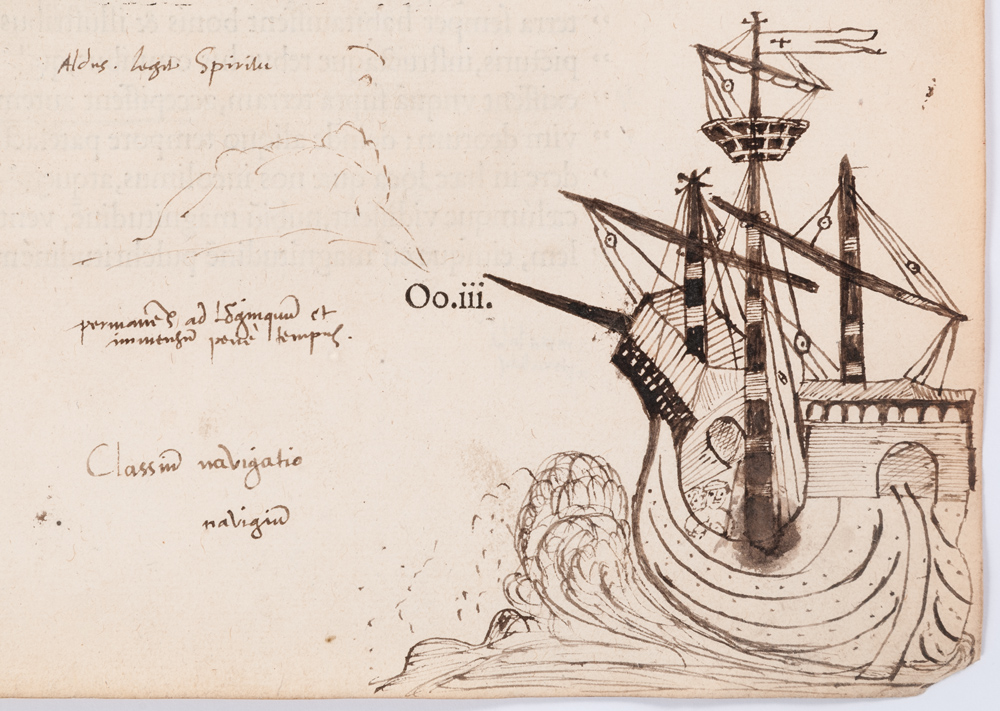
Twelve of Dee’s annotated books now in the RCP library have been chosen as part of the AOR phase 2. Included in their number are some of the most stunning and revealing books in the whole collection. A two-volume folio works of Cicero annotated by Dee as a student in the 1540s provides plenty of material for the modern scholar to chew over. There’s also more than one surprise as you turn its pages. In one instance, a sketch seems to resemble a Greek temple on a small island in flames: the nearby text of Cicero’s De legibus relates how the Persian king Xerxes set fire to the temples of the Greeks on the advice of the Persian magi. A larger instance of scholarly doodling is found in the same volume. In his De natura deorum Cicero quotes some lines from the Lucius Attius describing a huge bulk surging through the foaming seas. Next to this, Dee has drawn a most spectacular ship in full sail.

CN10550 - Cicero - Opera omnia%2c vol. 2%2c ship drawing close up- RCP-Mike Fear 1000px

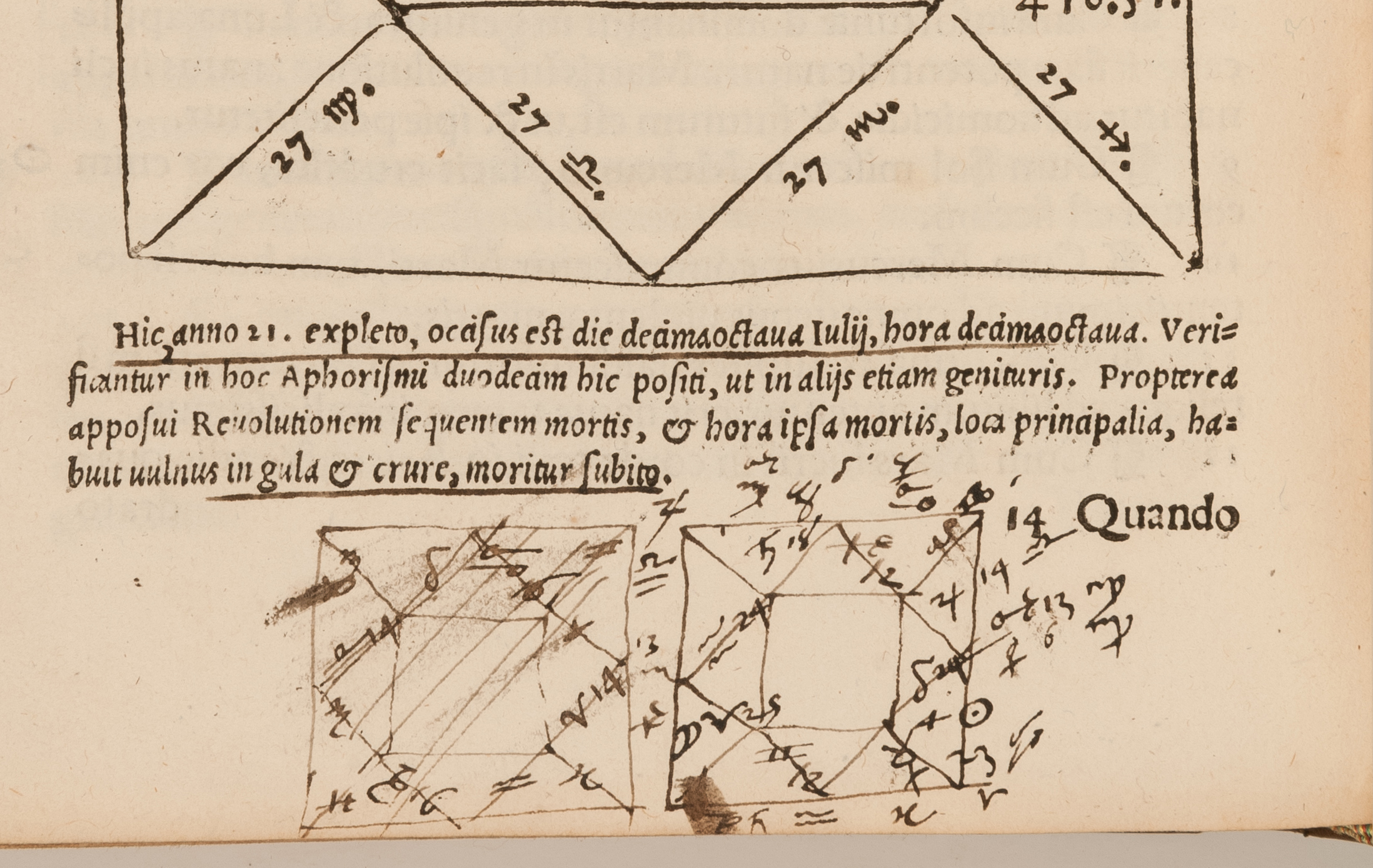
Less artistically adept, but no less interesting, are the astrological observations and calculations left by Dee in his copy of Girolamo Cardano’s Libelli quinque.

CN 7134 - Cardano%2c Libelli quinque%2c folio 228v%2c horoscope - photograph by Mike Fear%2c (c) RCP
Girolamo Cardano, Libelli quinque (Nuremberg: Johannes Petrejus, 1547)

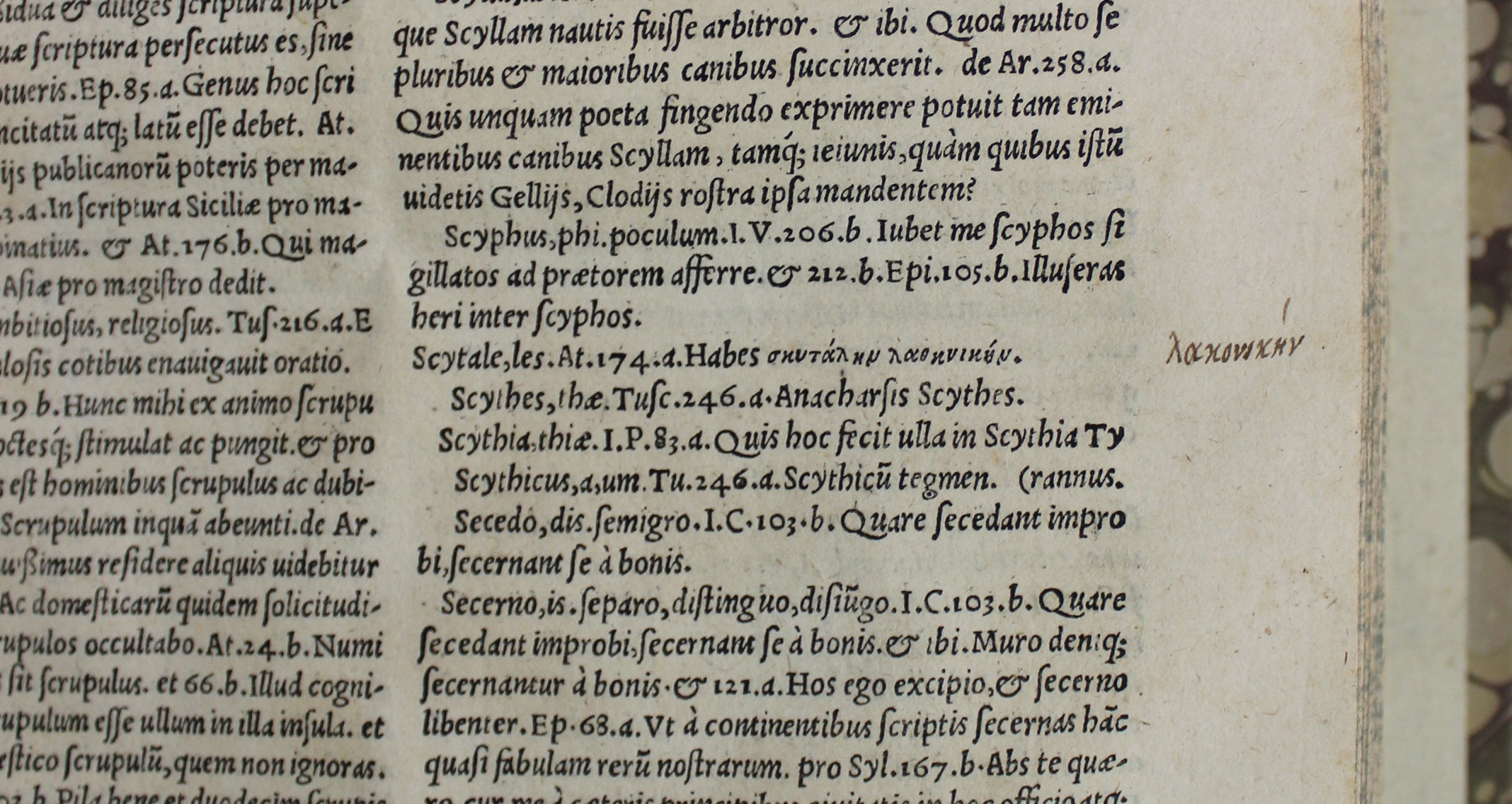
Aside from star objects such as the Cicero and Cardano, a point of interest appears in almost every book that retains any evidence of Dee’s ownership or use, not only the star objects. At first glance, there’s not much of interest in Dee’s copy of Mario Nizolio’s 1544 Latinae linguae dictionarium. We can probably assume that Dee acquired the book during his years as a student at St John’s College, Cambridge. There was once an ownership inscription on the title page, erased presumably by Nicholas Saunder, and there are very few annotations within the text. However, Dee does leave at least one trace. He notes the Greek word “Lakoniken” in the margin next to the lexicon entry “scytale”. Lakoniken is an alternative name for the Spartans, and the scytale is a tool the Spartans are reported to have used to perform transposition ciphers. In other words: this single annotated word might hint at Dee’s early interest in cryptography and code-breaking.

CN 10695%2c Nizolio%2c Dictionarium%2c 1544%2c scytale annotation cropped
Mario Nizolio, Latinae linguae dictionarium (Basel: Robert Winter, 1544), sig. Xx2

I’m delighted that books from our collection are part of AOR, and am excited to see what more we can start to learn about John Dee and Elizabethan scholarly culture once all of his copious annotations have been transcribed.

Katie Birkwood, rare books and special collections librarian, Royal College of Physicians, London

BIBLIOGRAPHY

Julian Roberts and Andrew G. Watson, John Dee’s library catalogue (London: Bibliographical Society, 1990)

About Jaap Geraerts

Posts navigation

← Previous 1 2 3 Next →

Archives

Categories

  • Case Studies
  • History of Reading
  • Scholarly dissemination
  • Technical Development
  • Uncategorized

Recent Posts

  • Virtual Office Hours
  • School’s In Session
  • Looking Back, Looking Forward
  • The Updated AOR Viewer is Now Live
  • Down to the Detail of Dee’s Greek Marginalia
  • What is the Archaeology of Reading (AOR)?
  • Who Are the Archeologists?
  • Partner Institutions
  • Contact
  • AOR Corpus
  • Bookwheel Blog
  • Help Documents
  • Downloads
  • Dissemination
  • Go To AOR Viewer
  • The Sheridan Libraries - Johns Hopkins University
  • Centre for Editing Lives and Letters - UCL
  • Princeton University Library
  • The Andrew W. Mellon Foundation
Facebook Twitter Pinterest